EffectStream
Build multi-chain dApps without the bridges
A Web3 engine for dApps, games & autonomous worlds
EVM · Midnight · Cardano · Bitcoin · Celestia · Avail · NEAR
What we'll cover
- 1. Why multi-chain dApps
- 2. How EffectStream works
- 3. Demos in the wild
- 4. Live: launch an EVM + Midnight template
- 5. Tools, links, try it yourself
Open source · TypeScript · one command to run a full local multi-chain stack
Why multi-chain dApps?
Context, and the problem everyone keeps hitting
The problem with "pick one chain"
- Your users & liquidity are spread across many chains — pick one and you cut off the rest.
- The usual fix is bridging assets over… and bridges are the #1 hack target in crypto — it's hard to do right.
- No single chain has it all — some are slow, some expensive, some lack the assets, or the features your app needs.
- Every chain has its own VM, wallets, tooling → supporting another chain means a rewrite.
What people actually want
on every chain + Use each chain's
strengths + No bridging
No custody risk
- EVM — deep markets & existing tokens · Midnight — privacy / ZK
- Celestia — cheap data availability · Cardano — native assets
A multi-chain dApp = one app that reads from many chains and folds them into one consistent state.
How EffectStream manages it
The short tech version
The core model
EVM · Midnight · … → Sync layer
normalize blocks → State machine
your TS logic → Indexed state
SQL / API
Read from many chains → fold into one deterministic state machine → query the result.
It's a sovereign rollup: inputs are ordered on-chain (data availability), your logic runs in your node, the resulting state is queryable.
Three pieces
Sync
Per-chain fetchers (viem for EVM, UTXORpc for Cardano, Midnight SDK, Bitcoin, Celestia…) poll finalized blocks and normalize them into one common format.
State machine
You write a typed grammar of commands + one handler each, in TypeScript. The runtime routes each input and commits SQL atomically per block.
Batcher
Users sign inputs and POST them over HTTP. The batcher packs many into one on-chain tx. Storage-first — survives crashes.
The payoff: non-custodial
- All real interactions land on the chains, not inside your node.
- Users keep full custody of their L1 assets the whole time.
- “Even if your app gets hacked, users' L1 assets are not at risk.”
Plus: complex logic runs in TypeScript (not Solidity), so game state, physics, and rich rules are finally practical.
The shape of it
Demos in the wild
Real apps & templates, working today
Safe Solver
Same logic over Arbitrum and Midnight blocks · deterministic randomness per block · play it live ▶
Tarochi
A fully on-chain autonomous game — the volume proof: over 1M+ transactions, gas subsidized · 4-layer rollup stack + Cardano DEX · built in GameMaker.
EVM-Cardano Explorer
A full local EVM + Cardano dev env from one command — Hardhat + YACI DevKit + Dolos. Mint NFTs, send ADA, one unified feed — minutes, not the days a Cardano indexer sync usually takes.
Launch an EVM + Midnight app
From git clone to a running cross-chain dApp
What we're building
On EVM
An ERC-721 NFT. Public ownership, standard Transfer events.
On Midnight
A private property added via a ZK circuit — only the owner can run it; the result is published for the app to read.
One database unifies both chains. Public token + private metadata, no bridge.
The whole launch
git clone https://github.com/effectstream/effectstream.git
cd effectstream/templates/evm-midnight-v2

bun i          # install dependencies

bun run dev    # 🚀 compiles contracts AND boots the entire local stack

open http://localhost:10599    # 👀 the running dApp in your browser
One command — bun run dev — compiles the contracts and orchestrates everything below.
It launches everything for you — in order
The orchestrator runs the whole dependency graph from that one command:
Hardhat · Midnight node, indexer, proof server → 🔨 Compile
EVM + Compact → 🚀 Deploy
contracts → 📜 Your custom scripts → 🖥️ Dev tools + frontend
▼ waits until every dependency is ready ▼
You declare this graph once in config — no manual wiring, no "start these 8 terminals."
The demo flow
- Open localhost:10599 → block heights from both chains ticking live.
- Mint an ERC-721 on the EVM side.
- Watch the sync node index it in ~a second — it appears in the app.
- Run the Midnight ZK circuit to attach a private property.
- See the property show up — one record, two chains.
- Optional: hit
localhost:9999/api/erc721→ raw JSON.
The running app
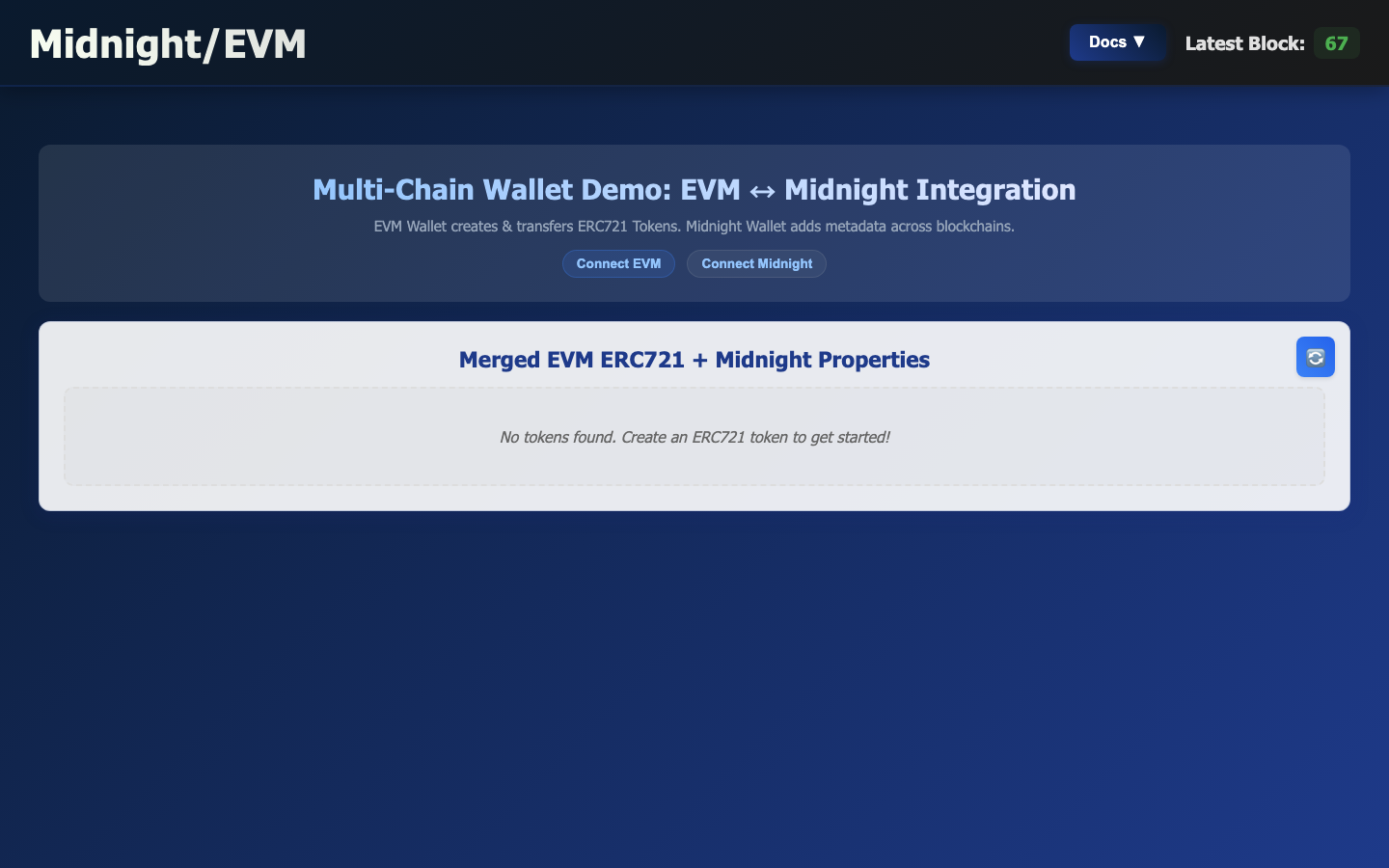
Live local boot — block height ticking, EVM ↔ Midnight wallet demo, one merged token view.
More tools & how to try it
The toolbox · talking to chains
Chains
Full sync for EVM, Midnight, Cardano, Bitcoin, Celestia, Avail, NEAR. Add one by declaring it in your config.
Primitives
Typed event watchers — ERC-20 / ERC-721, Midnight contract state, Bitcoin & Cardano addresses. You declare what to track.
Batcher
Users sign inputs → bundled into one on-chain tx. Storage-first & crash-safe — and it can pay gas for your users (next slide).
The toolbox · building your app
Sync
Reads the chains automatically and orders inputs deterministically — every node computes the same state.
State machine
A grammar of commands + one handler each, in TypeScript. SQL commits atomically per block.
API
Your indexed application state, queryable over HTTP — power any frontend.
Orchestrator
One command runs your whole local multi-chain stack. You declare the processes in your config — run only what your app needs.
@effectstream/wallets
One walletLogin() across MetaMask, Cardano CIP-30, Midnight, Mina, Polkadot, Algorand… polling hidden.
All TypeScript
No build step in dev — write your logic, run it, iterate.
Sponsor your users' transactions
The batcher submits inputs on the user's behalf — your app holds the key and pays the gas. So you can offer Web2-style, gas-free UX:
Gasless onboarding
Users sign, you pay — no gas, no faucet, no bridge to get started.
Metered & tiered
Add a policy: subscription → 5 free tx/day, rate-limits, allowlists — enforced before submit.
Proven
Tarochi subsidized 1M+ tx this way — users never touched gas.
It's just custom batcher validation — see the batcher-validations template.
Give it a try
git clone https://github.com/effectstream/effectstream.git
cd effectstream/templates/evm-midnight-v2
bun i && bun run dev- Code — github.com/effectstream/effectstream
- Docs — effectstream.github.io/docs
- Blog — /docs/blog
- Play — safesolver.midnight.fun
Templates to start from: minimal · evm-midnight-v2 · evm-cardano · chess-v2 · preorder
Thank you 🙏
Questions?
github.com/effectstream/effectstream · effectstream.github.io/docs
Topics we can dig into
How it works
Indexer impact · finality & slow settlement · batcher mechanics · "just a metadata standard?"
The template
Ready to clone? · common cross-chain pitfalls · private data ↔ EVM linkage
Capabilities
>2-chain swaps · how ordering / time works · wallets for partners
Do recent indexer issues affect our indexer?
- The chain only moves forward when it can confirm blocks closed at or before the target time — otherwise it waits.
- So a degraded upstream indexer makes sync pause and resume, never advance on bad data — state stays deterministic, nothing corrupts.
- Sync reads from the chain's indexer/RPC and is decoupled from it; it catches up when the source recovers.
Sync times & slow finality (rollups settling for days)?
- Each chain has a
confirmationDepth— sync waits N blocks before treating a block as final (EVM ~12, BTC ~6, instant-finality 0). - A per-chain delay ≈
depth × blockTime + bufferabsorbs latency & reorg risk; slow/deep-settlement chains get a higher value. - The deterministic NTP "Main" clock ticks independently, so the app keeps a steady tick-rate regardless of any one chain's settlement speed.
Batcher — per chain, then sync? Not cross-network at once?
- Correct. The batcher batches per chain / per adapter — independent queues, one bundled tx per chain — and the sync layer picks each up.
- It is not doing a single atomic operation across multiple networks simultaneously.
- Batch triggers: time / size / value / hybrid / custom. Confirmation:
no-wait·wait-receipt·wait-effectstream-processed.
Is this mostly a metadata standard for publishing across networks?
- No — it's a full execution + state model: read many chains → deterministic state machine → queryable state.
- The metadata/NFT-projection standards (PRCs) are an optional feature, not the core.
Ready for people to clone the Midnight-EVM work now?
- Yes — early release but stable: only fixes are being applied, no API or structural changes.
- You only need to clone if you want to add infra — otherwise just pull the
@effectstream/*npm packages. - Docs: effectstream.github.io/docs
Common issues devs hit with cross-chain apps?
- Finality differences & reorgs — handled by per-chain
confirmationDepth. - Different block times / ordering — handled by the NTP "Main" clock.
- RPC reliability & rate limits — you still need an RPC, but you can slow query frequency to match your RPC's limits (per chain).
- Per-ecosystem wallet & address formats — abstracted by typed primitives + the wallets package.
How is the private data tied to the metadata on Ethereum?
- Tied together in the L2 layer — a deterministic Postgres DB. Each EffectStream is a node; every node has the same deterministic database. No bridge.
- You can mix & match any chain feature. Here we read the Midnight Ledger as if it were events — so you inherit Midnight's security.
- Selective disclosure: we reveal only "Token XXX ↔ YYY on Midnight" — you could keep that secret instead.
Swaps across >2 chains at once (BTC ↔ ETH ↔ NIGHT)?
- Yes. An action on A can trigger actions on both B and C — optimistically (parallel) or sequentially.
- You decide the sequence. It's not a bridge by nature — but you can build one on top.
What determines transaction order? How is time managed across networks?
- Reads are ordered & deterministic — events map onto a deterministic "Main" NTP clock by source block height + time, so every node reconstructs the same order.
- Writes are best-effort — they happen whenever they're accepted; batchers retry, but still depend on external factors (gas prices, asset no longer available, bad tx).
What do the wallets mean for partners?
- One
walletLogin()across MetaMask/EVM, Cardano CIP-30, Midnight (Lace), Mina, Polkadot, Algorand, Avail. Users keep L1 custody — partners never hold funds. - Full sync + batcher + wallet on EVM, Midnight, Cardano, Avail, Bitcoin; others are wallet-connect / sign-only today.
- Plus JS testing wallets (Midnight · EVM · Cardano) to drive features end-to-end — great for automated & AI-assisted build/test.