An Open Achievement Standard for On-Chain Games
Steam has achievements. Xbox has Gamerscore. PlayStation has Trophies. But on-chain games? No standard way to track player accomplishments across games. We built PRC-1, an open standard that any EffectStream game can implement, plus a portal where players see all their achievements in one place.
PRC-1: the achievement standard
We created PRC-1 (Paima Request for Comment), a community standard similar to CIPs for Cardano or ERCs for Ethereum, but for the EffectStream game ecosystem. PRC-1 defines how games register, track, and expose achievements through a standard HTTP API.
The spec is published at effectstream/midnight-game-api-spec.
A game implementing PRC-1 exposes two endpoints:
GET /achievements/public/listreturns all achievements defined by the game (name, description, display metadata)GET /achievements/wallet/:walletreturns which achievements a specific player has earned, with timestamps and completion data
The achievement list response is a flat TypeScript shape - no chain-specific fields, no platform-specific fields:
interface AchievementPublicList {
  achievements: {
    name: string;              // Unique achievement ID, e.g. "speed_demon"
    displayName: string;       // Player-facing title
    description: string;       // How to unlock
    isActive: boolean;         // Currently unlockable?
    score?: number;            // Optional point value
    category?: string;         // Optional grouping ("Gold", "Diamond", ...)
    percentCompleted?: number; // Percentage of players who have it
    iconURI?: string;          // Badge image URL
    iconGreyURI?: string;      // Badge image URL when not yet earned
    spoiler?: 'all' | 'description'; // Hide details until unlocked
    startDate?: string;        // ISO8601, optional time-limited start
    endDate?: string;          // ISO8601, optional time-limited end
  }[];
}
Per-player completion follows a matching shape, keyed by achievement name with completion timestamps and optional incremental progress (progress / total). The full schema is in prc-1.md.
Any game that implements these endpoints is automatically discoverable by achievement portals, leaderboard aggregators, and third-party tools. The standard is intentionally minimal: it defines the interface, not the implementation. Games track achievements however they want internally; they just expose results through these endpoints.
PRC-6: Midnight dApp integration extension
For games running on the midnight.fun portal, we extended PRC-1 with PRC-6 (the Midnight dApp Integration Interface). PRC-6 adds:
- Channels for categorizing content within a game (modes, seasons, maps)
- Leaderboards with ranked player standings per channel
- Metrics for game-level statistics (total players, active sessions, transaction volume)
- Identity resolution to map session wallets to main wallets via delegation, so achievements earned through auto-sign sessions get correctly attributed to the player's primary identity
PRC-6 is what powers the rich game cards on midnight.fun. Each game tile shows live player counts, leaderboard positions, and achievement progress, all pulled from the standard API.
A PRC-6 application advertises its metadata, achievements, and channels at a single root endpoint:
GET {BASE_URL}/metrics
{
  "name": "Cyber Drifter",
  "description": "High-octane neon racing.",
  "achievements": [
    {
      "name": "speed_demon",
      "displayName": "Speed Demon",
      "description": "Finish a lap under 60 seconds.",
      "isActive": true,
      "percentCompleted": 14.2
    }
  ],
  "channels": [
    { "id": "leaderboard", "name": "Lap Time",
      "scoreUnit": "Lap Time (s)", "sortOrder": "ASC" },
    { "id": "kos", "name": "Knock Outs",
      "scoreUnit": "KOs", "sortOrder": "DESC" },
    { "id": "volume", "name": "USD Volume",
      "scoreUnit": "USD Volume", "sortOrder": "DESC", "auth": true }
  ]
}
The platform reads this once per game and uses it to render the game card, then queries each channel and per-user profile as needed.
The interesting trick is identity resolution. A query on a session wallet returns the resolved main wallet's stats, with the delegation chain made explicit:
GET {BASE_URL}/metrics/users/mn_session_abc123?channel=leaderboard
{
  "identity": {
    "address": "mn_main_driftking",
    "delegatedFrom": ["mn_session_abc123"],
    "displayName": "DriftKing"
  },
  "achievements": ["speed_demon", "first_blood"],
  "channels": {
    "leaderboard": {
      "stats": { "score": 45.2, "rank": 1 }
    }
  }
}
A player using auto-sign may hold dozens of session wallets across a game's lifetime; the platform collapses them all back to one main wallet for reputation and leaderboard purposes.
The full PRC-6 spec, including all channel definitions, authentication rules, and snapshot vs. cumulative semantics, lives at prc-6.md.
Implementing it in a game
The spec repository ships with a runnable reference server that implements every endpoint against in-memory fixtures. The /metrics route is a few lines of Fastify:
import Fastify from "fastify";
import { APP_NAME, APP_DESCRIPTION, ACHIEVEMENTS, CHANNEL_DEFS }
  from "./data/store.js";

const app = Fastify();

app.get("/metrics", async () => ({
  name: APP_NAME,
  description: APP_DESCRIPTION,
  achievements: ACHIEVEMENTS,    // your achievement definitions
  channels: CHANNEL_DEFS,        // your metric channels
}));

await app.listen({ port: 3000 });
There is no SDK to install. PRC-6 is just HTTP. A new game spending an afternoon on this gets discoverable on midnight.fun and queryable by every third-party tool that speaks the standard.
Live implementation: three games on midnight.fun
PRC-1 and PRC-6 are implemented in three live games on the midnight.fun portal:
- Block Kart Legends - racing achievements (lap times, win streaks, distance milestones)
- Kachina Kolosseum - PvP combat achievements (victories, combos, rank progression)
- Safe Solver - puzzle achievements (completion speed, streak bonuses, difficulty tiers)
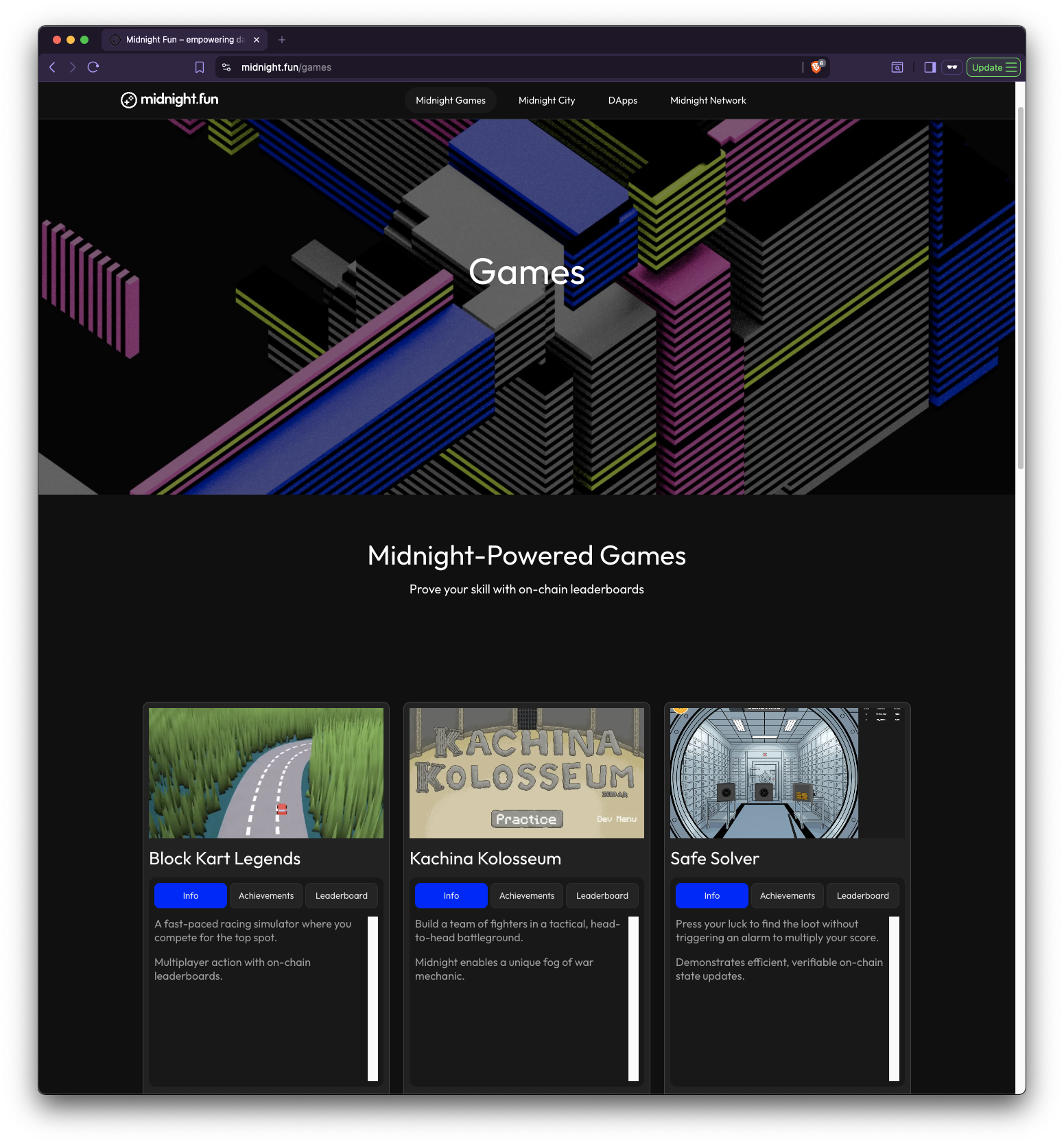
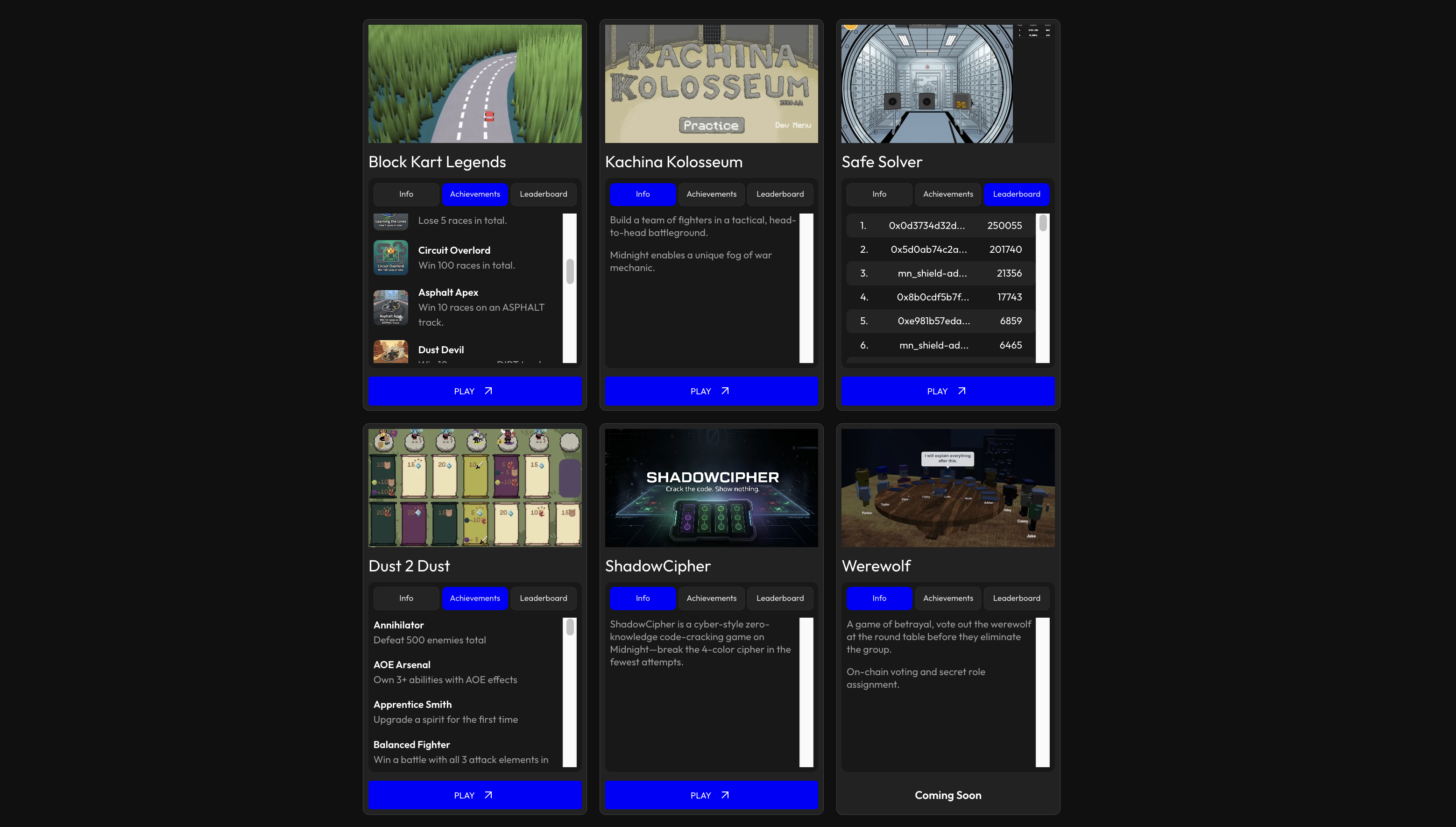
The screenshot shows the midnight.fun portal pulling data from all three games. Each game card displays live achievement counts and leaderboard positions, sourced from the PRC-1 and PRC-6 APIs. There's no centralized database here; the data lives in each game's node, and the portal queries it on the fly.
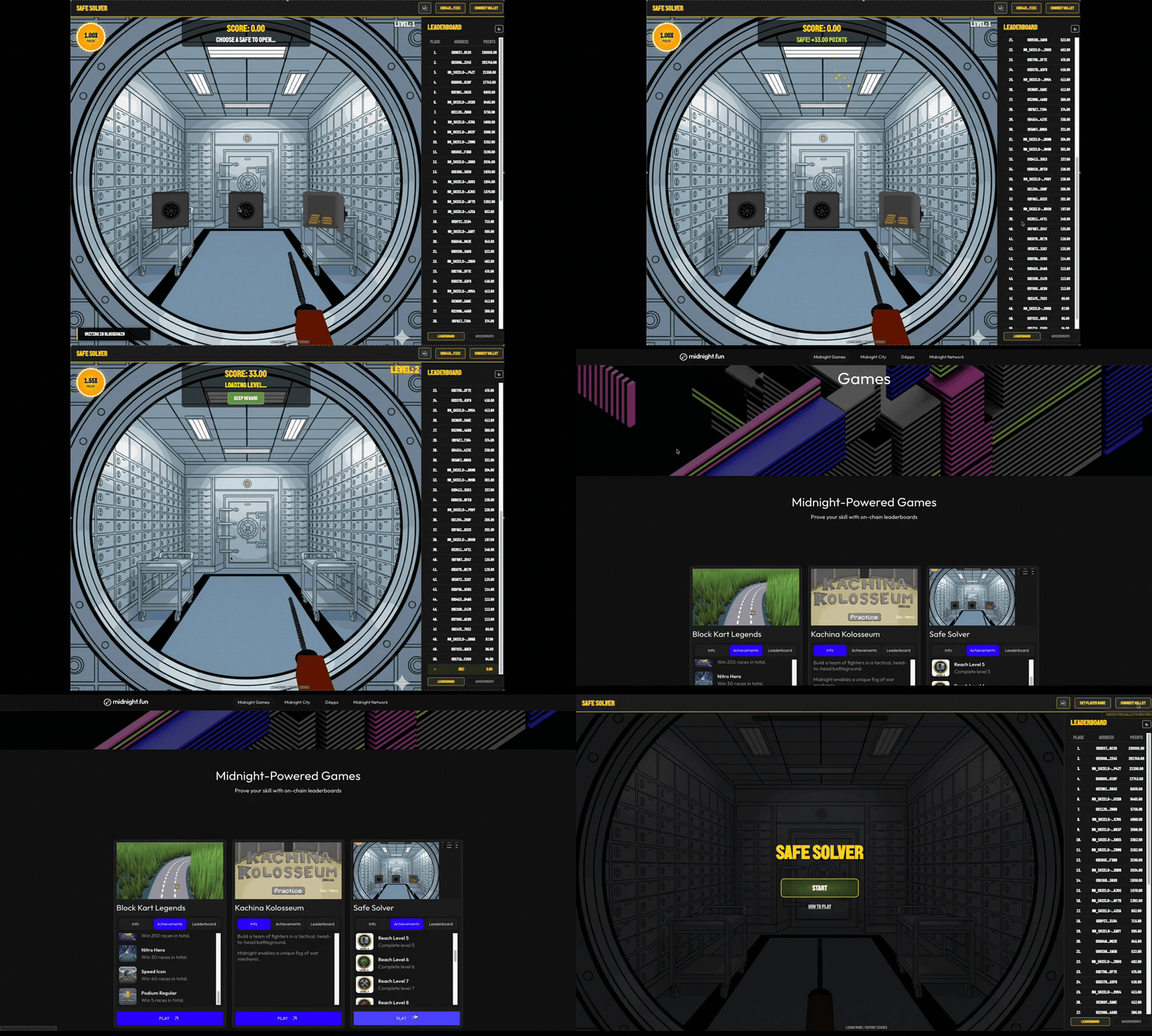
The walkthrough below shows the full earn-to-display loop: a player plays a game, unlocks an achievement, and the unlock surfaces immediately on the live leaderboard via the PRC-6 endpoints.
At a glance - earning points in Safe Solver, then the same wallet's achievements visible on the midnight.fun portal:
How it works under the hood
When a player connects their wallet to midnight.fun, the portal queries each game's PRC-1 endpoint to fetch that player's achievements. Because the standard uses wallet addresses as the primary identifier, achievements are cross-game and cross-platform by default: any portal or app can query any PRC-1 game.
For games using auto-sign (session key delegation), PRC-6's identity resolution makes sure achievements don't get "lost" on temporary session wallets. The delegation chain maps session keys back to the player's main wallet, so everything gets attributed correctly no matter which signing method was used.
An open ecosystem
Unlike platform-locked achievement systems (Steam, Xbox, PlayStation), PRC-1 achievements follow your wallet, not your platform account. Any app can aggregate achievements from any PRC-1 game. There's no central authority controlling the registry. And PRC-6 shows how you can extend the base standard for specific platforms without breaking compatibility.
The achievement system code is built into EffectStream. Any new game built with the framework gets PRC-1 support out of the box: define your achievements as data, and the framework handles tracking and the API. Every new game that adopts the standard makes the whole ecosystem richer.