Engine Integrations: From Local Development to Mobile
EffectStream is designed to integrate with any game engine or platform. This article covers four distinct integrations, each showing a different technology combination: modern multi-chain local development tooling, a traditional game engine, social platform frames, and a mobile app.
EVM-Cardano local development environment
One of the biggest friction points for multi-chain developers is setting up a local dev environment. Syncing a Cardano indexer like Carp can take days on testnet and even longer on mainnet, which makes rapid iteration pretty much impossible. We built a template that replaces this entire workflow with an instant localhost setup.
The EVM-Cardano template, available in the monorepo, combines:
- Hardhat v3 for EVM smart contract development and a local EVM chain
- YACI DevKit for a local Cardano devnet
- Dolos with UTxORPC for Cardano indexing via gRPC
The result: spin up a full multi-chain dev environment (EVM + Cardano) in minutes, not days.
The template includes an explorer UI for interacting with the local environment. You can mint NFTs on EVM, send ADA on Cardano, and see cross-chain events in a unified feed:
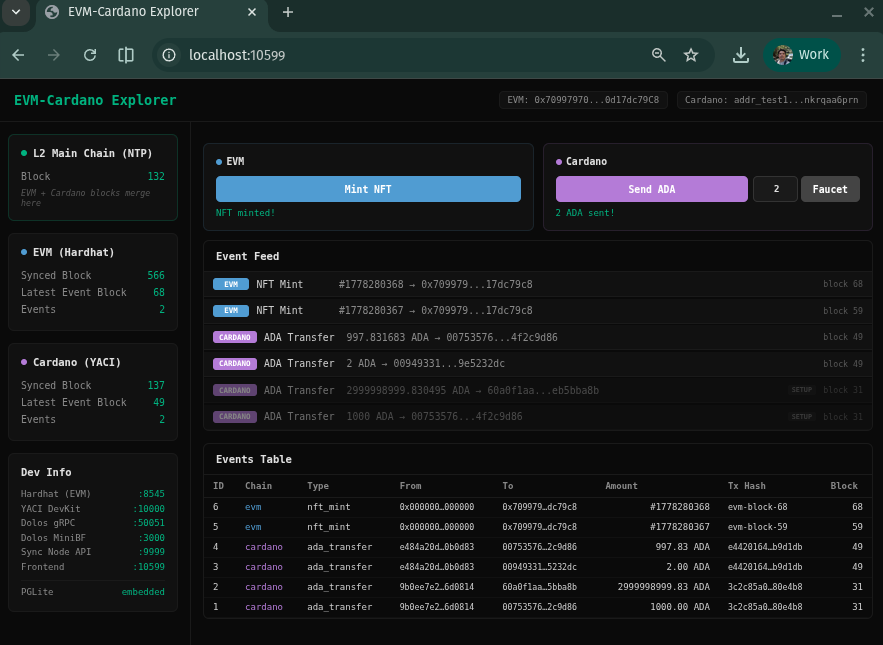
This is a complete local dev environment for building cross-chain applications. Write smart contracts on both chains, test interactions between them, iterate fast. No testnet, no waiting for chain sync.
Controlling the stack: the orchestrator
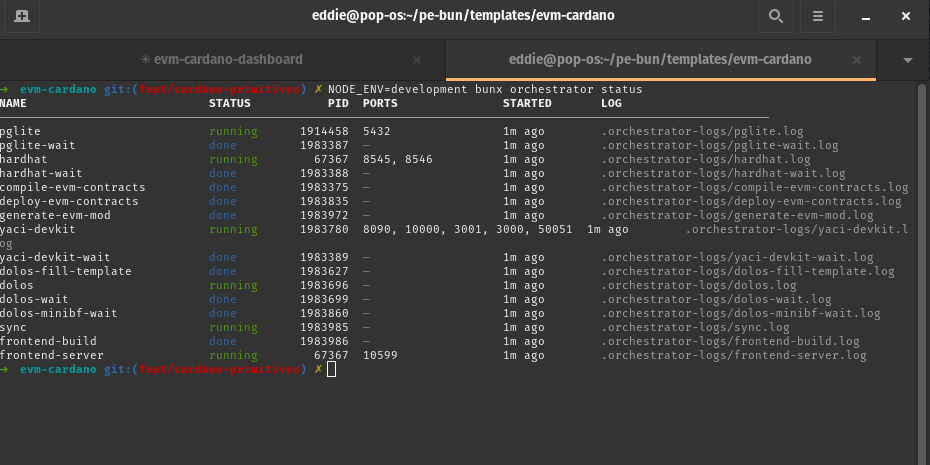
A multi-chain dev environment is not one process - it's six or seven, with dependencies between them: PGLite has to come up before the sync node, Dolos needs cardano-node, the contracts have to be deployed before the frontend can talk to them. We built bunx orchestrator as the master controller for this. It launches every process in dependency order, restarts individual ones, follows their logs, and silences the noisy ones, all from a single CLI.
$ bunx orchestrator --help

orchestrator - Bun-based process orchestration CLI

Usage:
  orchestrator <command> [options]

Commands:
  start   [config|name...]    Start all processes, or specific ones by name
  status                      Show status of running processes
  restart <name>              Restart a specific process by name
  stop    [name]              Stop a specific process (or all if no name given)
  list    [config]            List processes in config without starting them
  silence [name...]           Suppress terminal output for processes
  unsilence <name...>         Resume terminal output for processes
  logs    [name...]           Follow background daemon log files (like tail -f)

Global options:
  -c, --config  <path>        Config file (default: auto-detected)
  -h, --help                  Print help

Options for `start`:
  -b, --background            Run as a detached background daemon
  -p, --port    <n>           Orchestrator API port (default: 4747)
  -o, --only    <p1,p2,...>   Run only these processes (+ dependencies)
  -e, --except  <p1,p2,...>   Skip these processes
  -s, --serial                Launch one at a time instead of in parallel waves
  --no-deps                   Launch only named processes, skip dependency resolution
  --log-dir     <path>        Log directory when using -b (default: .orchestrator-logs)
  --no-api                    Disable the HTTP API server
  --silence     <p1,p2,...>   Suppress terminal output for these processes

Options for `status`:
  -f, --follow                Continuously refresh the status table (1s interval)
In practice, the developer workflow is just:
bunx orchestrator start              # bring up the whole stack
bunx orchestrator status             # see what's running and what failed
bunx orchestrator restart midnight-node   # bounce a single process
bunx orchestrator logs sync-node     # tail the logs of one process
bunx orchestrator stop               # tear everything down
The --only and --except flags let you run partial stacks - useful when you're iterating on the sync node and don't need the frontend rebuilding, or when you're testing the batcher in isolation. --background runs the whole orchestrator as a detached daemon with logs going to files, which is how the e2e test suite runs the same stack on CI.
The point is that the same bun run dev command that boots the EVM-Cardano template also boots the cardano-delegation template, the zk-cardano template, and every other template in the monorepo - they all share the orchestrator and just declare a different process graph in their config.
Game Maker integration
Not every on-chain game needs to be built from scratch. We created a template that integrates EffectStream with Game Maker, one of the most popular 2D game engines. Game designers use familiar visual tools for gameplay while EffectStream handles the blockchain backend: on-chain state, wallet interactions, and multi-chain settlement.
The point here is that EffectStream isn't limited to web-based games. Any engine that can make HTTP calls can talk to an EffectStream backend, and Game Maker's event-driven architecture maps naturally to EffectStream's state machine model.
Farcaster Frame integration
Farcaster Frames are mini-applications that run directly inside Farcaster's social feed. We built a template that turns an EffectStream game into a Frame, playable without leaving the feed. No app install required.
This is a completely different distribution model. Instead of "download our app and connect your wallet," it's "play this game right here in your feed." Every share is a playable instance. The social feed becomes the game platform.
The integration handles the constraints of the Frame environment (limited UI real estate, server-side rendering requirements, Farcaster's auth model) while keeping full EffectStream backend functionality.
Mobile with GPS
The most ambitious integration: a game template combining GPS location data for iOS and Android. Location-based gameplay where the assets you find, collect, and trade are real on-chain tokens.
The mobile app communicates with an EffectStream backend that manages on-chain state, while the mobile layer renders game objects at GPS-determined positions. It shows that EffectStream works well beyond the browser.
The common thread
| Integration | Platform | What's new |
|---|---|---|
| EVM-Cardano | Local dev | Instant multi-chain dev environment, replacing days-long Carp sync |
| Game Maker | Desktop engine | Traditional game engine + blockchain backend |
| Farcaster Frame | Social feed | Play on-chain games without leaving the social platform |
| Mobile GPS | iOS/Android | Location-based on-chain gameplay |
All templates are open-source in the game templates repository. The EVM-Cardano template with its Dolos-based local development stack is probably the most impactful: it removes the biggest barrier to Cardano development by getting rid of the sync time that's historically made local testing impractical.