Stake Pool Delegation Part 1: Connecting Cardano SPOs to On-Chain Applications
Cardano's stake pool ecosystem has millions of ADA delegated across hundreds of pools, but delegation has always been a one-way relationship: delegators earn rewards, and that's it. What if games and apps could react to where you delegate? What if stake pool operators could offer in-game benefits to their delegators? EffectStream now makes this possible with a new PoolDelegation primitive that streams delegation changes in real-time.
The challenge: indexing delegation state
Delegation changes on Cardano are ledger state transitions, not traditional transactions. When a user delegates to a new pool, there's no explicit "delegation event" in the transaction log; the change shows up in the ledger state at epoch boundaries. That makes delegation harder to index than token transfers or smart contract interactions.
The original approach used Carp as the indexer, but Carp requires syncing the full Cardano chain history. That takes days on testnet and even longer on mainnet. For local development and rapid iteration, it was a non-starter.
The solution: Dolos + UTxORPC Watch
We replaced Carp with Dolos, a lightweight Cardano node that exposes chain data via the UTxORPC gRPC protocol. The key part is the UTxORPC Watch module, which provides real-time transaction streaming with filtering:
- By address - watch all transactions involving a specific address
- By delegation part - watch transactions by stake credential, finding all UTxOs delegated to a specific stake key
- By asset policy - watch transactions involving tokens from a specific policy
For stake pool delegation, the "by delegation part" filter is the important one. It lets EffectStream detect when any address changes its delegation to or from a monitored pool, without scanning the entire chain.
The PoolDelegation primitive
The PoolDelegation primitive is one of five Cardano primitives in EffectStream. It reads delegation events from Dolos via UTxORPC and materializes them into PostgreSQL using EffectStream's IVM (Indexed View Materializer). See the Cardano Primitives documentation for the full reference.
The primitive tracks:
- Stake registrations - new stake addresses entering the system
- Delegation changes - an address moving from one pool to another
- Deregistrations - stake addresses leaving the system
All state is kept in PostgreSQL materialized views, giving applications fast query access to current delegation state without re-scanning the chain. When a delegation change occurs, the event flows through EffectStream's funnel system into the application's state machine as a first-class event, just like a smart contract interaction or token transfer.
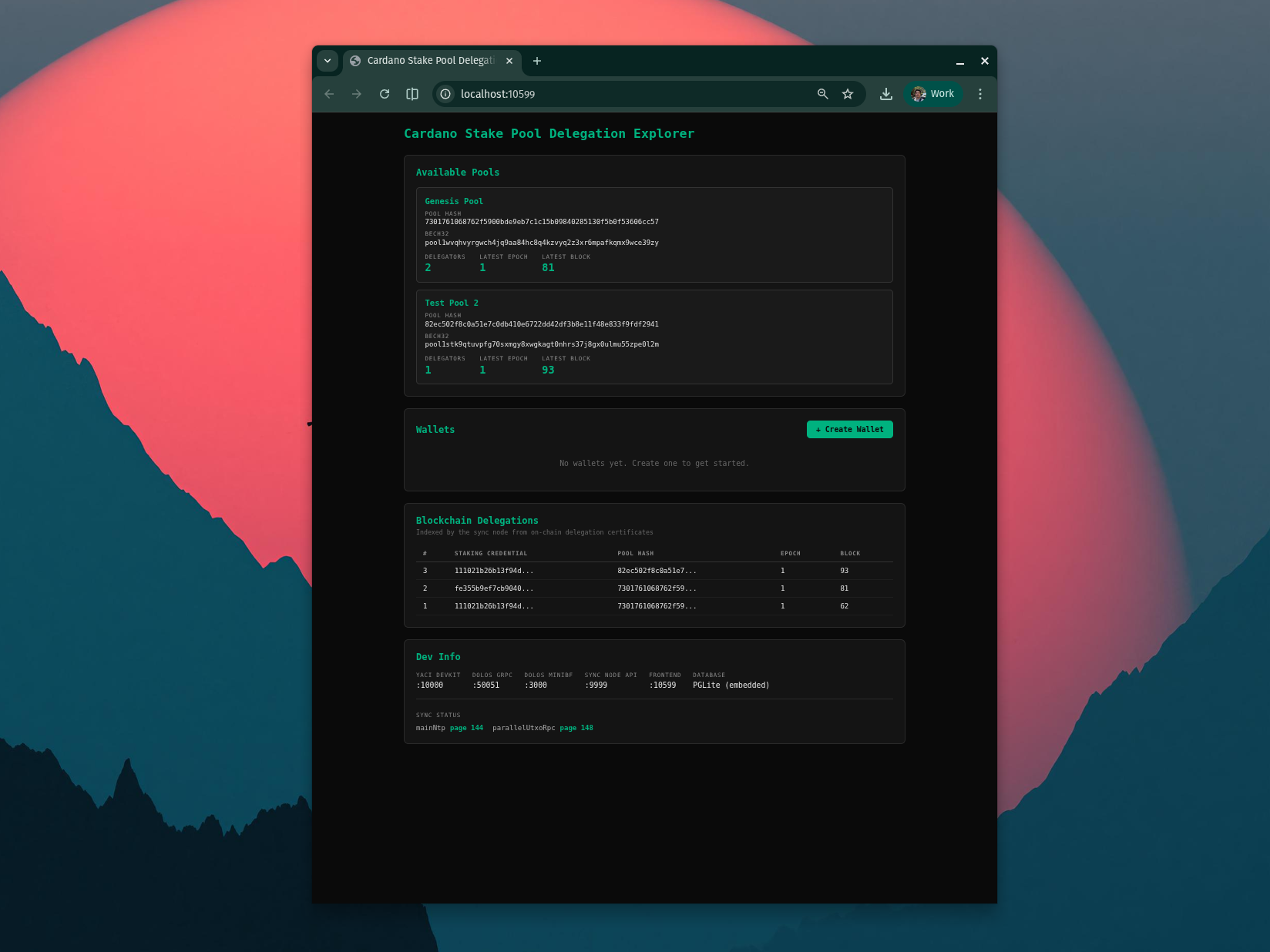
Here's the Cardano Stake Pool Delegation Explorer dApp, where you can look up delegation info, register stake keys, and trigger delegations:
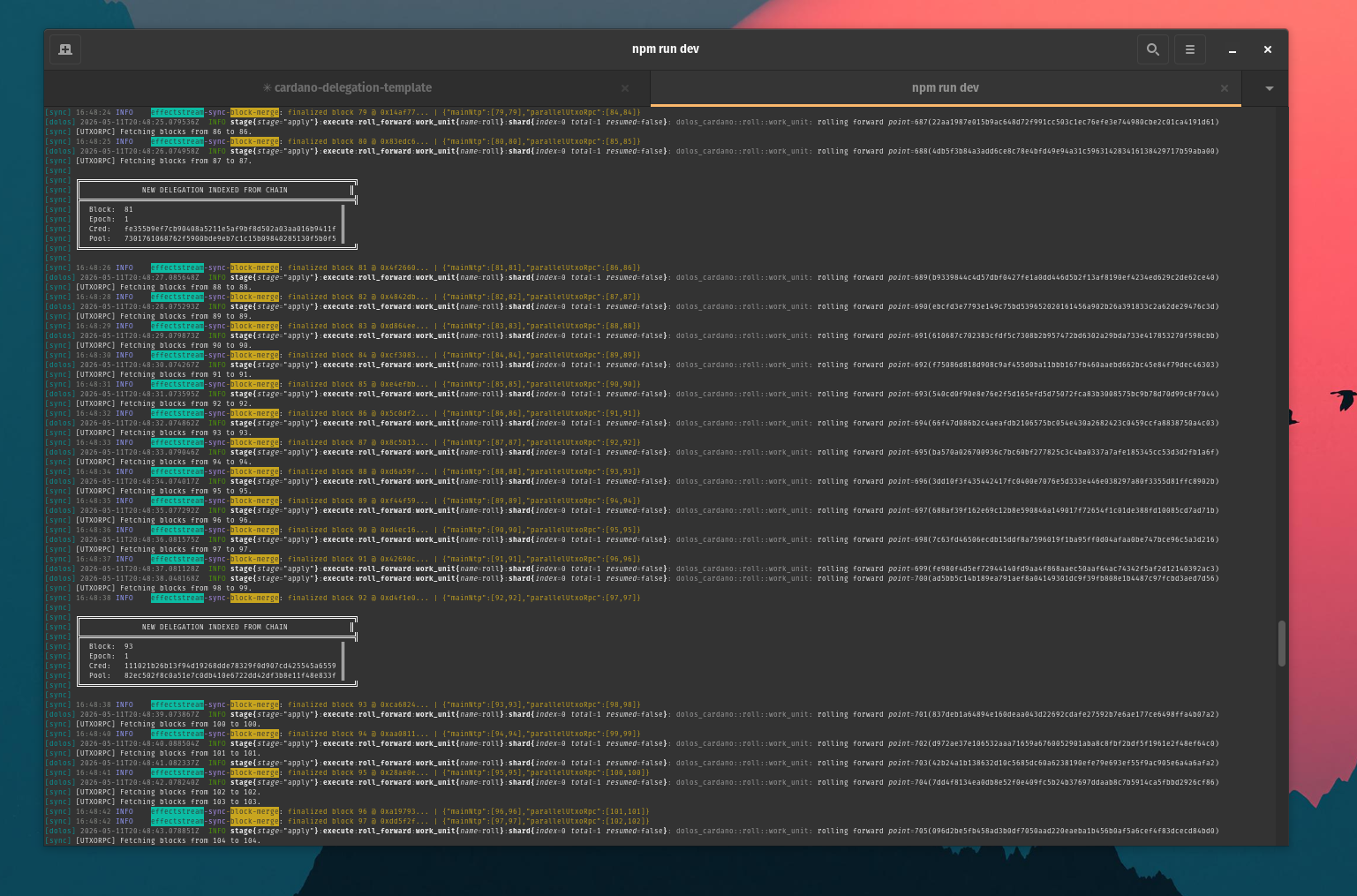
And this is the terminal output showing EffectStream detecting delegation changes as they happen, with the state machine reacting to each one:
What developers can build
With delegation data flowing into the state machine, developers can build game logic that reacts to where players delegate:
- "This area is accessible only to delegators of Pool X" (unlock content)
- "All delegators of Pool Y receive a bonus item at epoch boundary" (distribute rewards)
- Adjust game parameters based on which pools your players support (dynamic difficulty)
- Delegators of partner pools get free transaction batching via the
BATCHER_CARDANO_ENABLED_POOLSconfig (the SPO covers the cost)
End-to-end testing
The PoolDelegation primitive is covered by EffectStream's E2E test suite, which verifies the full Cardano primitive lifecycle. The delegation tests cover stake address registration, initial delegation to a pool, delegation change detection, and state verification in PostgreSQL materialized views. All tests run against a local Dolos instance with YACI DevKit, so CI runs fast with no mainnet or testnet dependencies.
The bigger picture
Stake pool delegation becomes a game mechanic. SPOs offer in-game benefits, players choose pools based on gameplay advantages, and a new economic layer sits on top of Cardano's existing delegation system. Delegation goes from a passive yield-earning activity to an active strategic decision: you delegate to a pool not just for staking rewards, but for the games and apps that pool supports.
- PoolDelegation primitive source - implementation
- Cardano delegation template - starter project
- Cardano Primitives documentation - full reference for all five Cardano primitives
- UTxORPC Watch Module - streaming transaction protocol
- Dolos - lightweight Cardano node