EVM-Midnight Token Metadata
- Location:
/templates/evm-midnight - Highlights: EVM & Midnight Interoperability. Web Application to create ERC721 Tokens and add metadata through a Midnight Contract.
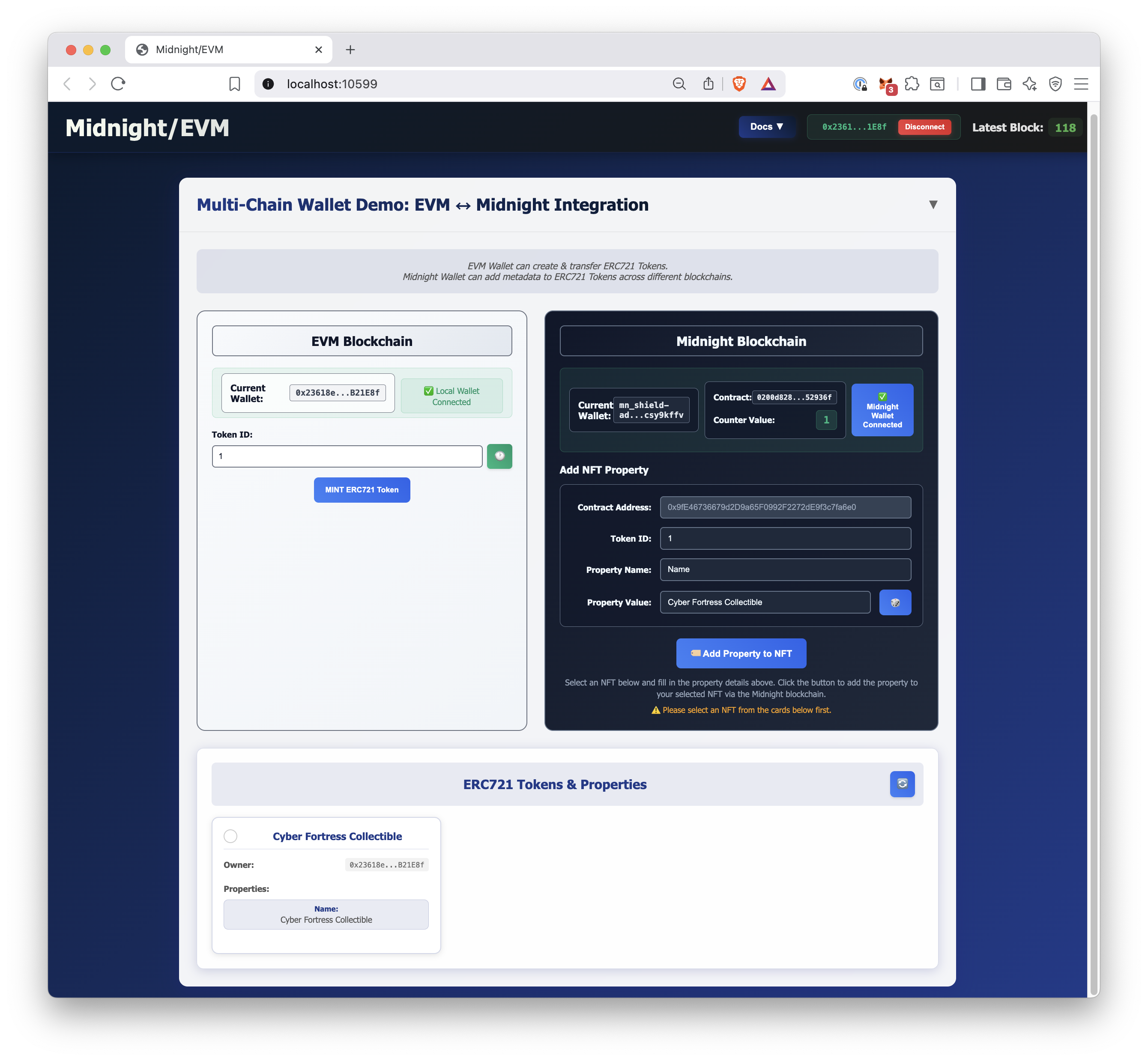
The evm-midnight template is a powerful starting point that demonstrates one of Effectstream's core strengths: multi-chain interoperability. It showcases a complete, end-to-end dApp that seamlessly combines a public, asset-focused EVM chain with a private, computation-focused ZK chain (Midnight).
Core Concept: Extending ERC721 Tokens with Private Metadata
The goal of this template is to create a dApp where users can own a standard ERC721 Token on an EVM chain, but then use the privacy features of Midnight to add or update metadata associated with that NFT.
- The ownership of the Token is public and managed by the EVM contract.
- The special properties or "enchantments" of the NFT are managed on Midnight. Only the owner can execute the ZK transaction to add a property, but the result (the new property) is made public on Midnight's ledger for the Effectstream to see.
This pattern is a blueprint for many real-world applications, such as:
- Private Stats: An Token character's stats (e.g., strength, intelligence) could be private until a battle.
- Sealed-Bid Auctions: Bids for an NFT could be kept private until the auction ends.
- Verifiable Randomness: An NFT could be associated with a random attribute that is generated privately and then revealed.
Quick Start
# Check for external dependencies
./../check.sh

# Install packages
deno install --allow-scripts && ./patch.sh

# Compile contracts
deno task build:evm
deno task build:midnight

# Launch Effectstream Node
deno task dev
Now you should see the dApp running in your browser!
Terminal
Browser
The Components in Action
When you run deno task dev for this template, the Process Orchestrator sets up a complete local environment:
- Hardhat EVM Node: A local EVM blockchain.
- Midnight Stack: The full local Midnight environment, including the node, indexer, and proof server.
- Paima Services: The development database, log collector, TUI, and the Paima Explorer.
- Effectstream: Node to sync the chains.
- Frontend: A simple web interface to interact with the contracts.
On-Chain Logic
1. The EVM Contract (Erc721Dev.sol)
The EVM side is a standard, minimal Erc721Dev contract. Its only job is to manage the minting and transferring of Tokens. Effectstream will monitor its Transfer event to track ownership.
// In packages/shared/contracts/evm/src/contracts/ERC721Dev.sol
pragma solidity ^0.8.20;

import {ERC721} from "@openzeppelin/contracts/token/ERC721/ERC721.sol";

contract Erc721Dev is ERC721 {
    constructor() ERC721("Mock ERC721", "MERC") {}

    function mint(address _to, uint256 _tokenId) external {
        _mint(_to, _tokenId);
    }
}
2. The Midnight Contract (counter.compact)
The Midnight contract is where the logic for updating metadata lives. Its addPropertyToTokenID circuit accepts four private inputs, which in this template are repurposed to represent the EVM contract address, the Token's token ID, and a key-value pair for the new property.
When a user executes this circuit, the transaction updates the contract's public ledger, revealing the new property without disclosing the private inputs used in the computation.
// In packages/shared/contracts/midnight/contract-round-value/src/counter.compact
pragma language_version >= 0.17;

import CompactStandardLibrary;

// These are the public state variables Paima will monitor.
export ledger round: Counter;
export ledger contract_address: Bytes<64>;
export ledger token_id: Bytes<64>;
export ledger property_name: Bytes<32>;
export ledger value: Bytes<32>;

// This is the private state transition.
export circuit addPropertyToTokenID(
  contract_address_: Bytes<64>,
  token_id_: Bytes<64>,
  property_name_: Bytes<32>,
  value_: Bytes<32>,
): [] {
  round.addPropertyToTokenID(1);
  // The 'disclose' keyword makes the private input public
  // by writing it to the corresponding ledger variable.
  contract_address = disclose(contract_address_);
  token_id = disclose(token_id_);
  property_name = disclose(property_name_);
  value = disclose(value_);
}
The State Machine (state-machine.ts)
The State Machine has two key State Transition Functions (STFs) that listen for events from these two chains.
1. transfer-assets STF (Listening to EVM)
This STF is triggered whenever an ERC721 Transfer event occurs on the EVM chain. Its job is to keep track of existing Tokens and the current owner.
// In packages/client/node/src/state-machine.ts
stm.addStateTransition(
  "transfer-assets",
  function* (data) {
    console.log("🎉 [TRANSFER-ASSETS] Transaction receipt:");
    console.log(JSON.stringify(data.parsedInput, null, 2));
    const { to, tokenId }: any = data.parsedInput;
    const contract_address = `0x1111...`

    // Update the database to record the new owner of the Token.
    yield* World.resolve(insertEvmMidnight, {
      contract_address,
      token_id: tokenId,
      owner: to,
      block_height: data.blockHeight,
    });
    return;
  },
);
And the SQL Query takes care of the database updates, and keeping track of all the Tokens and owner.
/** @name insertEvmMidnight */
INSERT INTO evm_midnight
    (contract_address, token_id, owner, block_height)
VALUES
    (:contract_address!, :token_id!, :owner!, :block_height!)
ON CONFLICT (contract_address, token_id)
DO UPDATE SET
    owner = EXCLUDED.owner,
    block_height = EXCLUDED.block_height
2. midnightContractState STF (Listening to Midnight)
This STF is triggered whenever the public ledger of the Midnight contract changes. Its job is to take the new metadata revealed by the ZK transaction and link it to the corresponding Token in the database.
// In packages/client/node/src/state-machine.ts
stm.addStateTransition(
  "midnightContractState",
  function* (data) {
    // 1. Decode the public ledger state from the raw Midnight payload.
    const payload: { /* ... */ } = data.parsedInput.payload;
    const decodeString = (x: { [key: string]: number }): string =>
      // ... decoding logic ...

    const contract_address = decodeString(payload.contract_address);
    const token_id = decodeString(payload.token_id);
    const property_name = decodeString(payload.property_name);
    const value = decodeString(payload.value);

    // 2. Check if we already know about this Token from the EVM.
    //    If not, create a record for it.
    const [evmMidnight] = yield* World.resolve(getEvmMidnightByTokenId, {
      contract_address,
      token_id,
    });
    if (!evmMidnight) {
      yield* World.resolve(insertEvmMidnight, {
        contract_address,
        token_id,
        owner: "",
        block_height: data.blockHeight,
      });
    }

    // 3. Insert the new metadata property into the database,
    //    linking it to the Token.
    yield* World.resolve(insertEvmMidnightProperty, {
      contract_address,
      token_id,
      property_name,
      value,
      block_height: data.blockHeight,
    });
  },
);
The property consistency is maintained by the database query:
/* @name insertEvmMidnightProperty */
INSERT INTO evm_midnight_properties
    (contract_address, token_id, property_name, value, block_height)
VALUES
    (:contract_address!, :token_id!, :property_name!, :value!, :block_height!)
ON CONFLICT (contract_address, token_id, property_name)
DO UPDATE SET
    value = EXCLUDED.value,
    block_height = EXCLUDED.block_height
By combining these two STFs, the Effectstream builds a unified view of the dApp's state, merging public ownership data from EVM with privately-added metadata from Midnight.