Night Bitcoin — Intent-Based Cross-Chain Swaps
Template:
templates/night-bitcoin-v2
Bridges are the standard way to move value between chains, and they are also the standard way to lose it: a bridge is a contract holding both sides' funds, and its security is the security of whoever controls it. This template shows the alternative. A user publishes an intent — a declaration of what they will give and what they want — to an ERC-7683 contract on Midnight. A market of competing fillers (solvers) quotes the trade, and the winner delivers the counter-asset out of its own inventory. No pooled custody, no wrapped assets, no canonical bridge contract.
What makes that safe is the arbiter. An Effectstream node syncs Bitcoin and Midnight into one ordered stream, records the intent and the payment as they land, and only pairs them once both are on-chain. If you are building anything that has to settle against two chains that cannot talk to each other — swaps, cross-chain payments, solver networks — this is the pattern to copy.
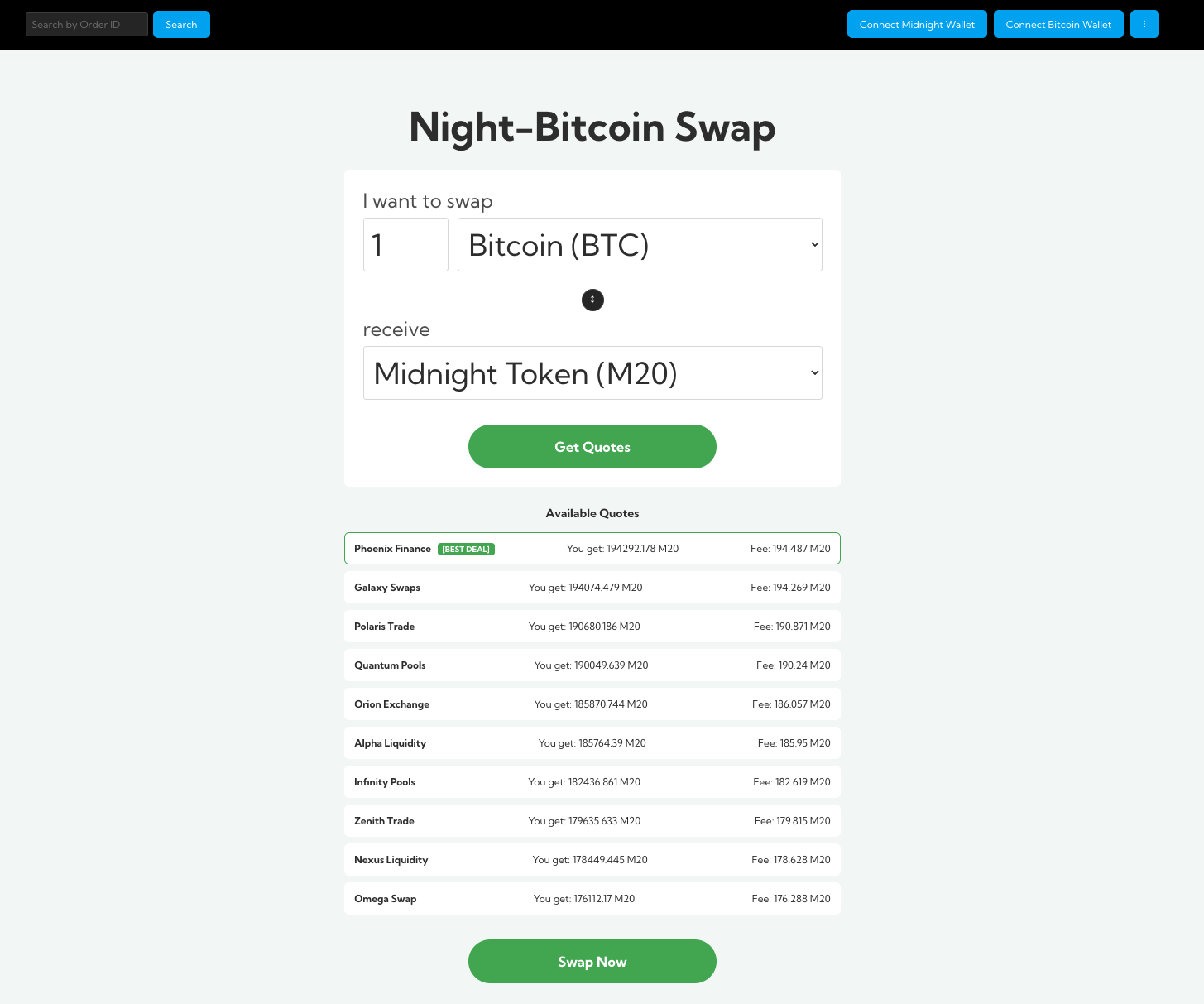
What this template shows
The intent/filler model, and why it needs no bridge. A swap here is three independent facts, each observable on its own chain:
- The user's intent, written to the ERC-7683 contract on Midnight
(
packages/contracts-midnight/erc7683/src/erc7683.compact). - The user's payment — BTC to a watched address, or an M20 unshielded UTXO spend on Midnight.
- The filler's payout to the user, submitted through the filler's own batcher.
Nobody holds a shared pool. The user pays, the filler pays, and the only thing that connects the two is a node that has independently indexed both chains and can therefore assert "the payment for this order id exists". A filler that takes a payment without delivering is simply never credited; a user who declares an intent and never pays never triggers a payout. The trust assumption shrinks from "the bridge is honest" to "the indexed chain state is what it says it is".
Where the filler lives. packages/filler/index.ts is one filler process. The
orchestrator launches three of them (Alpha Liquidity, Omega Swap, Quantum Pools
— see fillerDefinitions in start.dev.ts), each with its own port and its own
Bitcoin + Midnight wallets, so the local stack behaves like a competitive market rather
than a single privileged relayer. Each filler is an active agent, not a price feed:
it embeds its own @effectstream/batcher-sdk batcher with a BitcoinAdapter and a
MidnightAdapter, so when it wins an order it signs and submits the payout itself.
// packages/filler/index.ts
server.post("/api/quote", async (request, reply) => {
  const { orderId, fromToken, toToken, fromAmount } = request.body;

  const basisPoints = 10; // 0.01% * 10 = 0.1% => 10 basis points
  const conversionRate = getConversion(fromAmount, fromToken, toToken);
  const fee = (basisPoints * conversionRate) / 10000;
  ...
Two ways of observing a payment. BTC arrives as a transaction to a watched address,
picked up by PrimitiveTypeBitcoinAddress. M20 does not arrive as a contract event —
the user's transfer goes through the balancing batcher as a native unshielded UTXO
move, which fires no contract state change at all. The template therefore also runs
PrimitiveTypeMidnightUnshieldedSpend, which observes raw unshielded spends on
Midnight's ledger, and synthesises a matching transfers row. Both paths converge on
the same checkAndTransferFunds matcher in packages/node/state-machine.ts.
This is a demo settlement, deliberately simplified.
erc7683.compactdefinesvalidate_initialize,resolveandvalidate_resolvecircuits, but the flow here only callsinitialize: the state machine plays escrow-and-arbiter and drives the payout directly. A production build would have the filler callresolveand the node act purely as the settler.
Effectstream features used
| Feature | Where | Used for |
|---|---|---|
@effectstream/sm state machine | packages/node/state-machine.ts | Matching intents to payments and driving settlement |
Grammar (@effectstream/concise, builtinGrammars) | packages/node/grammar.ts | Typed inputs for the four primitives |
NTP main sync protocol (ConfigSyncProtocolType.NTP_MAIN) | packages/node/config.dev.ts | A single ordered timeline for two chains that share no clock |
Midnight contract state via PrimitiveTypeMidnightGeneric | packages/node/config.dev.ts | Reading the ERC-7683 and M20 ledgers |
Midnight unshielded spends via PrimitiveTypeMidnightUnshieldedSpend | packages/node/config.dev.ts | Observing native UTXO moves that fire no contract event |
Bitcoin RPC sync via PrimitiveTypeBitcoinAddress | packages/node/config.dev.ts | Watching the system deposit address on regtest |
Custom API routes (StartConfigApiRouter) | packages/node/api.ts | Quote fan-out, intent lookup, readiness, dev faucet |
Batcher MidnightBalancingAdapter (@effectstream/batcher-sdk) | packages/batcher/batcher.dev.ts | Fee-sponsored ("dust-free") Midnight transfers for users |
Batcher BitcoinAdapter + MidnightAdapter | packages/filler/index.ts | Each filler submits its own payouts on either chain |
Migrations + pgtyped queries (@effectstream/db) | packages/database/ | The intents / transfers / quotes clearinghouse |
Wallet connect (@effectstream/wallets) | packages/frontend/client/src/interface.ts | Midnight (Lace) login for signing intents |
Orchestrator (@effectstream/orchestrator) | start.dev.ts | Bringing up both chains, three fillers, batcher and frontend |
Quick start
Prerequisites
-
Bun.
-
The Compact compiler, on your
PATH. The contract packages compile withcompact compile +0.31.0(seepackages/contracts-midnight/erc7683/package.json), so install the toolchain and pin that release:curl --proto '=https' --tlsv1.2 -LsSf \https://github.com/midnightntwrk/compact/releases/latest/download/compact-installer.sh | shcompact update 0.31.0 -
openssl, used by the indexer launch script to generate a secret. -
A Midnight wallet that supports the
undeployednetwork (Lace Midnight preview) to sign intents in the dApp. -
No Docker, and no manually installed chain binaries: Bitcoin Core and the Midnight node, indexer and proof server are pulled in as npm packages (
@effectstream/bitcoin-core,@effectstream/npm-midnight-node,@effectstream/npm-midnight-indexer,@effectstream/npm-midnight-proof-server).
Run it
bun i
bun run dev
[!NOTE] The first
bun run devcompiles the two Compact contracts before anything else can start, which takes several minutes with no visible progress. That is not a hang — watch themidnight-contractprocess in the orchestrator output.
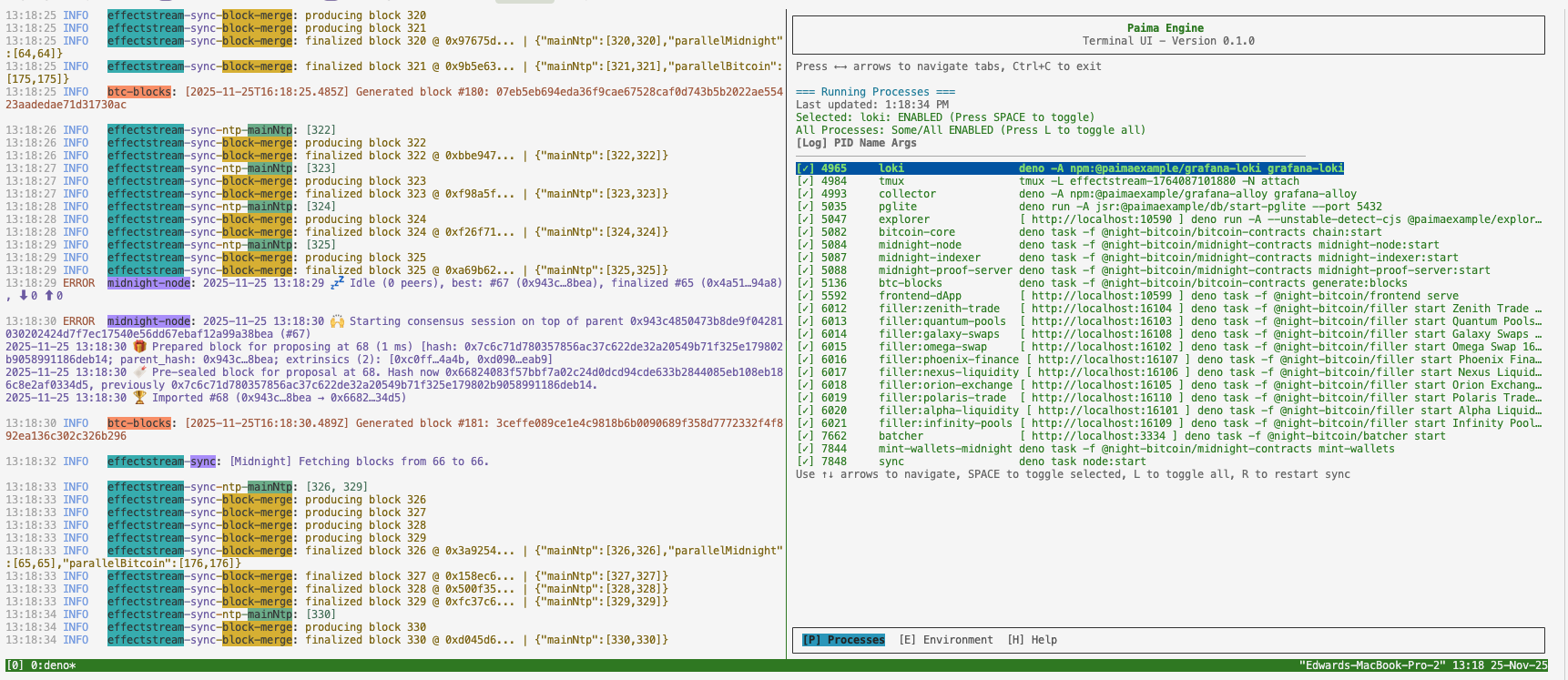
Once the sync process is up, open http://localhost:10599.
| Service | URL |
|---|---|
| Frontend (dApp) | http://localhost:10599 |
| Sync node HTTP API | http://localhost:9999 |
| Balancing batcher | http://localhost:3334 |
| Filler — Alpha Liquidity | http://localhost:16101 |
| Filler — Omega Swap | http://localhost:16102 |
| Filler — Quantum Pools | http://localhost:16103 |
| Orchestrator API | http://localhost:4747 |
| Midnight node RPC | http://127.0.0.1:9944 |
| Midnight indexer | http://127.0.0.1:8088 |
| Midnight proof server | http://127.0.0.1:6300 |
| Bitcoin Core RPC (regtest) | http://127.0.0.1:18443 |
| PGlite (Postgres) | localhost:5432 |
Other scripts:
bun run test             # full test suite (boots its own stack)
bun run build:midnight   # compile the Compact contracts only
bun run build:pgtypes    # regenerate pgtyped query types
bun run start:frontend   # Vite dev server for the frontend alone
bun run start:mainnet    # packages/node/main.mainnet.ts (see Configuration)
When working inside the Effectstream monorepo, run ./link.sh instead of bun i — it
installs dependencies and then symlinks every @effectstream/* package to its local
source.
Project structure
packages/
  batcher/               Balancing batcher — MidnightBalancingAdapter on :3334
  contracts-bitcoin/     Regtest helpers: wallet creation, faucet, transfers, block waits
  contracts-midnight/    Midnight node/indexer/proof-server scripts and contract deployment
    erc7683/             ERC-7683 intent contract (Compact source + generated bindings)
    unshielded-erc20/    "M20" unshielded fungible token (Compact source + bindings)
    indexer-standalone/  Standalone indexer config
  database/              000-init.sql migration and pgtyped queries
  filler/                One solver process: quote API, payout webhook, embedded batcher
  frontend/              React dApp (client/) served by a Fastify static server (server/)
  node/                  Sync node: config, grammar, state machine, API
  tests/                 infra / stm / frontend test phases
How it works
A BTC → M20 swap, end to end:
- Quote. The dApp posts to
POST /api/get-quoteson the sync node. That route fans the request out to all three fillers'POST /api/quoteendpoints, writes every returned quote to thequotestable, and hands the array back. The user picks one. - Intent declared. The dApp calls
initializeon the ERC-7683 contract via the user's Midnight wallet (packages/frontend/client/src/contracts/intents.ts), recordingmaxSpent_*(what the user gives),minReceived_*(what they want), the deadlines, and the chain ids. Nothing has moved yet. - Payment. The user sends BTC to the watched system address
bcrt1qfv6m6l5s6cgda09yr5nd8rnufkaz59d3aquq03. (In the M20 → BTC direction, the dApp instead callsm20_transferFrom, routed through the balancing batcher so the user pays no Midnight fees.) - Both chains observed.
parallelMidnightpicks up the contract state change andparallelBitcoinpicks up the transaction; both are ordered onto themainNtptimeline. The state machine writes anintentsrow and atransfersrow. - Match. Whichever arrives second triggers
checkAndTransferFunds, which looks up the counterpart by order id / amount / token / chain id. If either half is missing, it logs and returns — a half-finished swap is simply not settled. - Filler picks it up. On a match, the node marks the transfer used and the intent
resolved, then POSTs to the winning filler's
/api/notify-filler-intent-payment. The filler queues the payout on its embedded batcher: a Bitcoin transfer, or amint_unshieldedcircuit call for M20. - Filler is made whole. The node releases the user's side to the filler's wallet
(
transferFundson Bitcoin,transferFundson Midnight).
Grammar
Four inputs, one per primitive. Two use builtinGrammars; the unshielded-spend payload
is passed through as-is because its shape comes from the indexer.
// packages/node/grammar.ts
export const grammar = {
  "bitcoin-transaction": builtinGrammars.bitcoinAddress,
  "midnightContractStateERC20": builtinGrammars.midnightGeneric,
  "midnightContractStateERC7683": builtinGrammars.midnightGeneric,
  "midnight-unshielded-spend": [["payload", Type.Any()]],
} as const satisfies GrammarDefinition;
Each key matches a stateMachinePrefix in packages/node/config.dev.ts, which is what
binds a primitive to its transition.
State machine
packages/node/state-machine.ts registers one transition per grammar key. The
ERC-7683 handler decodes the intent out of the Compact ledger — Compact stores
Bytes<N> fields NUL-padded, and older payloads arrive as an object-of-bytes rather
than hex, so decodePaddedString handles both — inserts it, and immediately tries to
match:
// packages/node/state-machine.ts
yield* World.resolve(insertIntent, { ... });

yield* checkAndTransferFunds({
  type: "intent-received",
  orderId: parsedPayload.lastIntentEvent.orderId as string,
});
The Bitcoin handler is the mirror image: insert the transfer, then call
checkAndTransferFunds({ type: "transfer-received", ... }). Settlement is symmetric,
so the swap completes regardless of which leg lands first.
The unshielded-spend handler is the interesting one. A spend event carries only
{ owner, intentHash, outputIndex, txHash } — no amount, no recipient — so it is used
as a signal rather than a record: find the latest open M20 intent, look up the
winning filler's unshielded address, and synthesise the transfers row the matcher
expects. The template documents this simplification in place (it assumes at most one
outstanding M20 intent at a time).
Payouts run outside the state machine, in setTimeout(..., 0), so that network I/O to
the fillers never sits inside a deterministic transition.
API
packages/node/api.ts registers the routes the dApp uses. GET /health comes from the
runtime itself.
| Route | Purpose |
|---|---|
GET /health | Runtime liveness ({ status: "ok" }) |
GET /api/intents?orderId=… | One intent by order id, or 404 |
POST /api/get-quotes | Fan out to all fillers, persist quotes, return the array |
GET /api/check-processes | LOADING / FILLERS-NOT-READY / READY |
GET /api/faucet/btc?address=… | Development only. Fund a regtest address |
/api/check-processes is worth a look: it does not just ask the orchestrator whether
the filler processes exist, it probes each filler's /api/health directly, because a
running process does not mean listen() has resolved while the wallet is still
syncing.
POST /api/get-quotes also rejects BTC amounts at or below the 546-sat dust limit up
front, so a doomed swap fails with a readable message instead of a chain-level error.
The fillers expose their own small API: GET /api/health, POST /api/quote, and
POST /api/notify-filler-intent-payment.
Database
packages/database/migrations/000-init.sql creates three tables and
packages/database/sql/queries.sql holds the pgtyped queries over them.
| Table | Role |
|---|---|
intents | The authoritative ERC-7683 order state, unique on order_id, with resolved_by naming the winning filler |
transfers | A unified ledger of raw movements on both chains, with a used flag that stops one deposit satisfying two orders |
quotes | Audit trail of the off-chain quoting round, unique on (order_id, filler) |
The used boolean is the whole double-spend defence on the app side: matching sets it
in the same transition that marks the intent resolved.
Configuration
Dev defaults live in code and need no environment setup. The variables that exist:
| Variable | Default | Read by |
|---|---|---|
EFFECTSTREAM_API_PORT | 9999 | Sync node HTTP API |
PGLITE | set to true for the sync process | Use embedded PGlite instead of external Postgres |
ORCHESTRATOR_PORT | 4747 | /api/check-processes proxy target |
BATCHER_PORT | 3334 | packages/batcher/config.ts |
BATCHER_WALLET_SEED | built-in dev seeds | packages/batcher/config.ts |
BATCHER_POLLING_INTERVAL_MS | 250 | packages/batcher/config.ts |
BATCHER_STORAGE_DIR | packages/batcher-data | packages/batcher/config.ts |
MIDNIGHT_STORAGE_PASSWORD | set by start.dev.ts | Midnight node storage |
Frontend endpoints are Vite variables in packages/frontend/.env.dev
(VITE_API_URL, VITE_BATCHER_URL, VITE_MIDNIGHT_*), consumed at build time by
--mode dev.
Mainnet is not wired up. packages/node/config.mainnet.ts and main.mainnet.ts
are stubs, and both say so at the top of the file. The mainnet config already validates
the variables it will need — BITCOIN_RPC_URL, BITCOIN_RPC_USER,
BITCOIN_RPC_PASS, BITCOIN_START_BLOCK, MIDNIGHT_START_BLOCK, SYSTEM_WALLET_BTC,
optional NTP_START_TIME — and throws if they are missing, but the Midnight network id
is still the local one and the deposit-address flow is regtest-shaped. Treat
bun run start:mainnet as a skeleton, not a deployment path.
Testing
bun run test
packages/tests/run-tests.ts boots its own orchestrator stack from
packages/tests/start.test.ts, runs three phases, prints a summary and tears the stack
down again:
- Phase A — infrastructure. Bitcoin regtest reaches block > 100, the Midnight node and indexer answer, the Compact contracts deploy, and the filler wallets are created on both chains.
- Phase B — state machine, database, API. The migration has applied and the three
tables accept inserts (
stm/intents.test.ts);getLatestOpenIntentByTokenpicks the right row (stm/queries.test.ts); themidnight-unshielded-spendtransition is driven through the realgameStateTransitionsgenerator with a fabricated input and must produce the synthetic transfer and resolve the intent (stm/unshielded-spend.test.ts); and every API route returns the right shape and status, including the sub-dust rejection (stm/api.test.ts). - Phase C — frontend. The Vite build succeeds and the app renders under
playwright-core.
Driving a full cross-chain intent end to end needs live wallets, so it is out of scope for this suite; Phase B verifies the schema and API contract the flow depends on.
Where to go next
- Primitives — how
the four listeners in
config.dev.tsturn chain events into typed inputs. - State machine — the determinism rules that dictate why payouts run outside the transitions here.
- Bitcoin — regtest setup, address watching, and the Bitcoin batcher adapter.
- Midnight — Compact contracts, the indexer, and shielded vs unshielded addresses.
- Batcher overview — adapters, batching criteria, and the balancing adapter this template uses twice.
- EVM-Midnight template — the sibling template for a simpler two-chain sync without the solver market.