IPP: Verifiable Clinical Records on Cardano, Built on EffectStream
Medical records are an area that can gain from blockchain, but it hasn't been done at scale yet - so we wanted to start with small wins. The data itself - a patient's history, diagnoses, contact details - must stay private. But everyone who relies on it - the clinician next month, an auditor, the researcher who wants to publish from it - needs to know it hasn't been silently rewritten. Privacy and verifiability, with neither one cancelling the other out.
IPP is a working application that puts that combination on Cardano,
end-to-end: an iOS app for Chilean doctors and clinical staff to capture
women's-health intake forms, a Bun backend, a public web viewer, and a Cardano
anchor that records a hash of each chart on chain. It's built on Cardano with
tooling from EffectStream for local development, and is open-source at
effectstream/ipp-app.
It is also the first native-mobile, location-based AR template in the EffectStream series. This one is a field tool clinicians carry in their pocket, and also a social game, with leaderboard scoring.
The problem
Behind the cryptography is a concrete clinical bottleneck. In Chile:
- 2,000+ (known) people are on the waiting list for pelvic-floor care.
- There are not enough specialists to see them.
- Triage is expensive - scarce specialist time is spent sorting who needs what before anyone is treated.
- The data never becomes research. Cases are seen and forgotten; there is no dataset a clinician could publish from.
And the tools that exist do not close the gap:
- Today's systems only store. They are filing cabinets - they hold a record, but they do not help you trust it, act on it, or learn from it.
- No geo-location. Nothing shows where the need concentrates, so scarce specialists cannot be sent where they would help most.
- No way to explore augmented data. A clinician filling a form sees a blank field, never how this patient compares to their locality, country, or the world.
IPP attacks exactly these gaps, and each maps to a feature:
- Cheaper triage, by more hands. A structured, guided intake turns an expensive specialist task into a quick form - in the pilot, doctors even delegated logins to office staff to capture cases by phone.
- Location is first-class (GPS). Every record geocodes, so the map shows where need clusters and lets you plan interventions: "send a specialist to this zone."
- Location-based AR. At capture, each field is overlaid with its local / country / world context for the patient's real location; on the map, notes and areas are drawn over the real geography, turning patterns into plans.
- Capture becomes verifiable research. A filtered cohort is anchored to Cardano as a study whose dataset anyone can validate - the data finally has somewhere to go.
- Gamified so it grows. Points and a leaderboard make contribution visible and reward the clinicians who feed the dataset (and who write the papers).
The rest of this post is how that is built - and what happened when real doctors used it.
Gamification
Games come in many shapes, media, and types. Here we bring real-world, opt-in work into a gamified leaderboard: a clinician earns points for each record they capture, and the leaderboard tracks the top contributors. This has multiple benefits:
- It creates a sense of ownership and pride in the work they are doing.
- Social proof that their work is valued and contributing to a larger cause.
- It showcases the community and collaboration.
- You can see the data is clean, as top contributors will probably be well known and trusted.
- It helps show the app is alive.
- Keeps it fun!
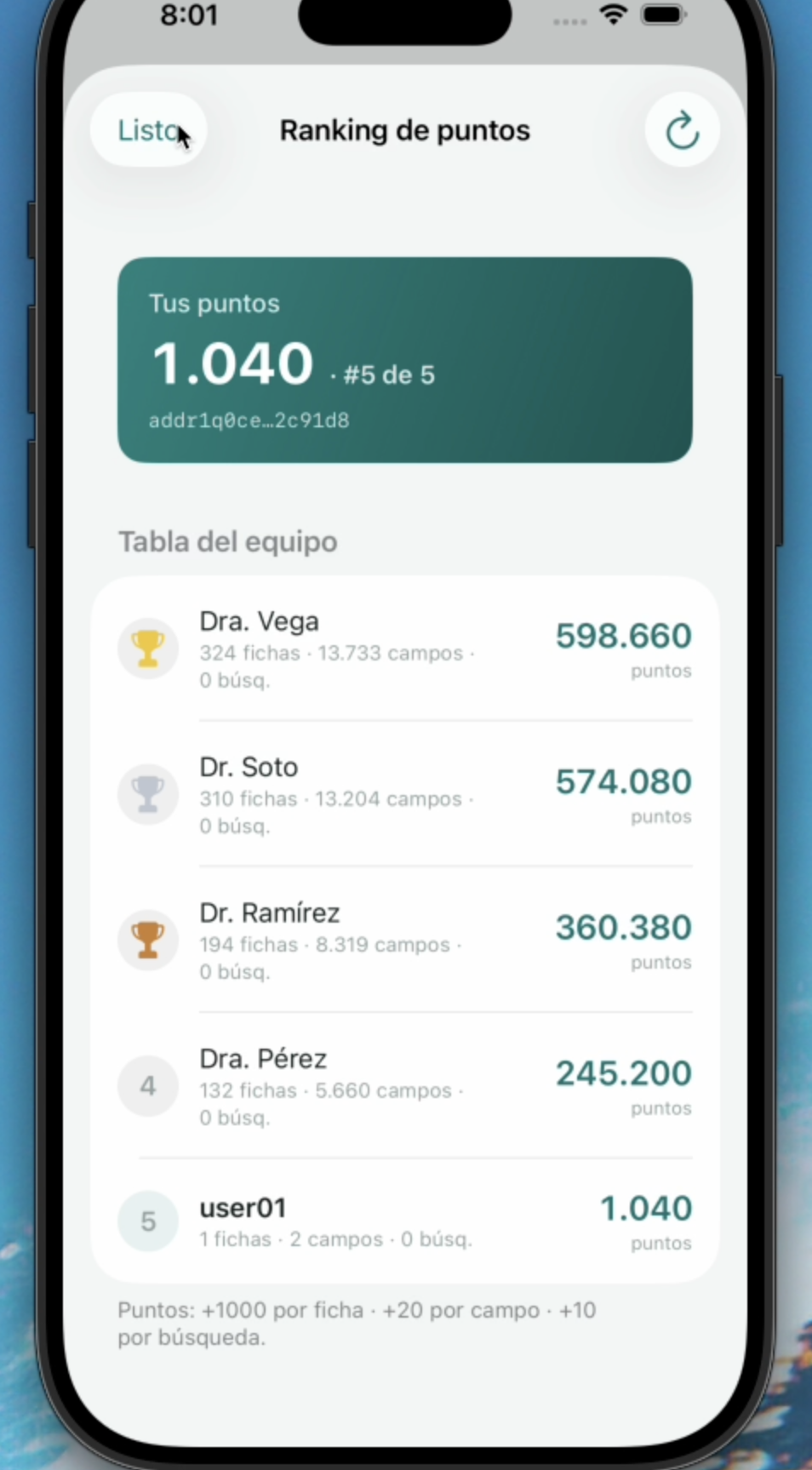 The built-in leaderboard: points per contributor - in the pilot, the signal of
who the research-minded (and willing-to-pay) clinicians are.
The built-in leaderboard: points per contributor - in the pilot, the signal of
who the research-minded (and willing-to-pay) clinicians are.
The trust gap
A clinical intake form has roughly seventy questions across four sections - demographic data, general medical history, gynecological history, and pelvic-floor assessment, in this case. Each filled-out form lives in more than one place at once:
- On the doctor's phone, where it's captured.
- In a shared database, where clinicians look it up later.
- In a published dataset, when the cohort becomes research.
(Patients can request their own record too - that's available, just not the focus here.)
The challenge isn't storage - Postgres is perfectly happy to hold a JSONB column. The challenge is trust. If a record changes between visits, nobody downstream can tell. If a doctor needs to prove to an auditor - or a journal - that the record they're reading today is the one they saved in March, there's no built-in mechanism; the row is just bytes controlled by whoever holds the connection string.
The anchor pattern fixes that without putting any private data on chain.
The anchor pattern
On Cardano you don't need a smart contract to anchor a hash - you attach it to
transaction metadata. IPP submits a tiny self-payment transaction carrying a
metadata label (8327) with three fields:
// tx metadata, label 8327
{
  "t": "ipp",                                  // kind: "ipp" record | "ipp-study" Merkle root
  "k": "<SHA-256(rut)>",                       // who, hashed - never identifiable data
  "v": "<SHA-256(canonical patient JSON)>"     // the record, hashed
}
Nothing about the patient's identity or medical content is recoverable from the
chain entry - both k and v are 32-byte hashes. But given the plaintext
record, anyone can recompute SHA-256(canonical JSON), find the latest anchor
for SHA-256(rut), and check the two match. If they don't, the record changed
since it was anchored. This is Cardano's own
CIP-100 "anchor" convention - a
rootHash written on chain to attest off-chain data - applied to clinical charts.
The same shape scales up: a study anchors one Merkle root over a whole cohort
of record hashes (t: "ipp-study"), so a published dataset can be validated
against a single on-chain value without ever putting the records on chain.
On a recent end-to-end run:
| Stage | Result |
|---|---|
CardanoAdapter.submit → Lucid builds tx + metadata | submitted to the Cardano node |
| Cardano | tx confirmed in seconds |
chain sync → CardanoTransfer primitive → state machine | row written to ipp_anchors |
CardanoAdapter.read / GET /api/v1/onchain/:key | returns the on-chain value - matches the submitted hash |
A metadata transaction costs a fraction of an ada.
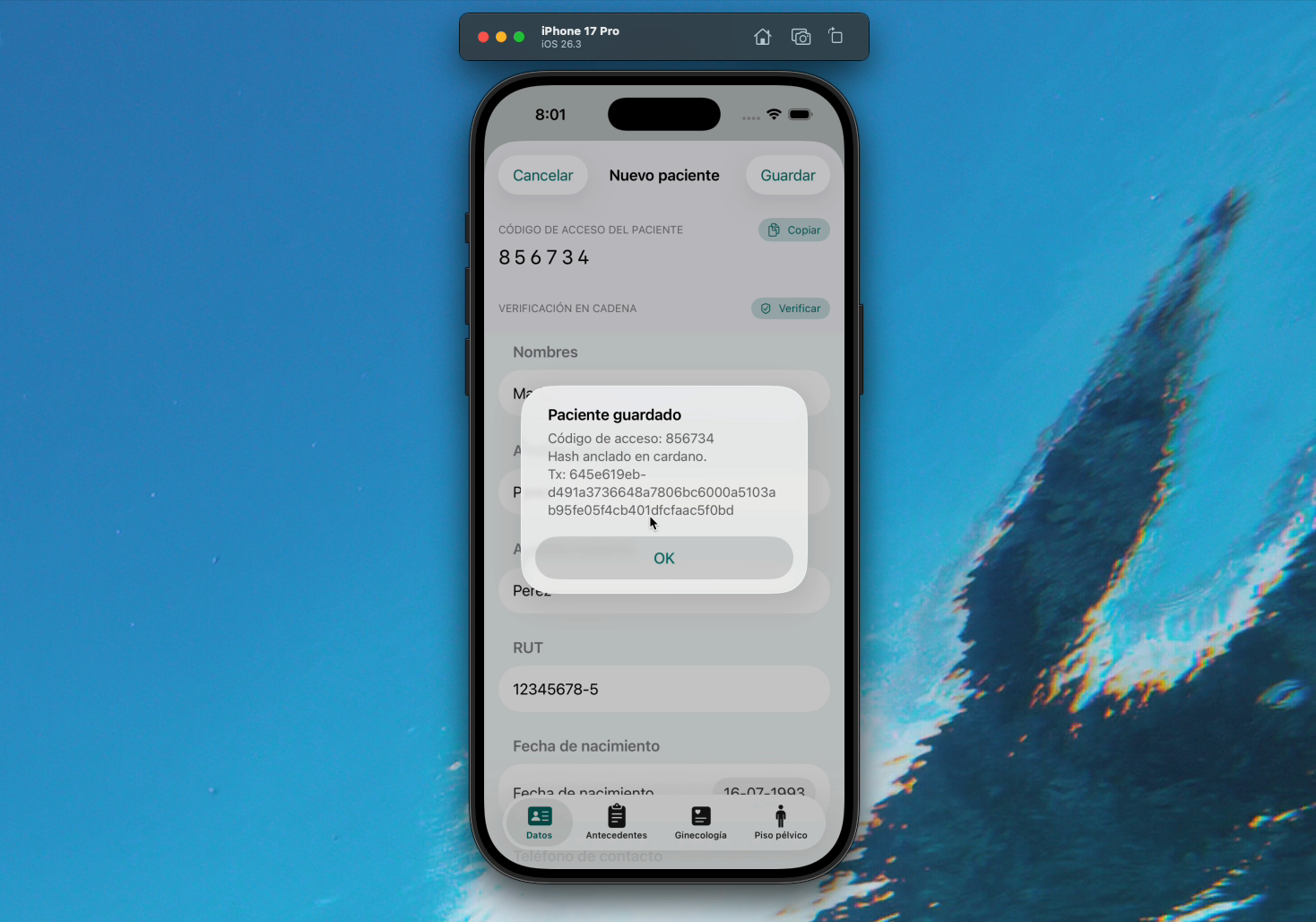 Saving a record in the app returns an access code and anchors the record's
SHA-256 hash to Cardano - the transaction id is shown right there.
Saving a record in the app returns an access code and anchors the record's
SHA-256 hash to Cardano - the transaction id is shown right there.
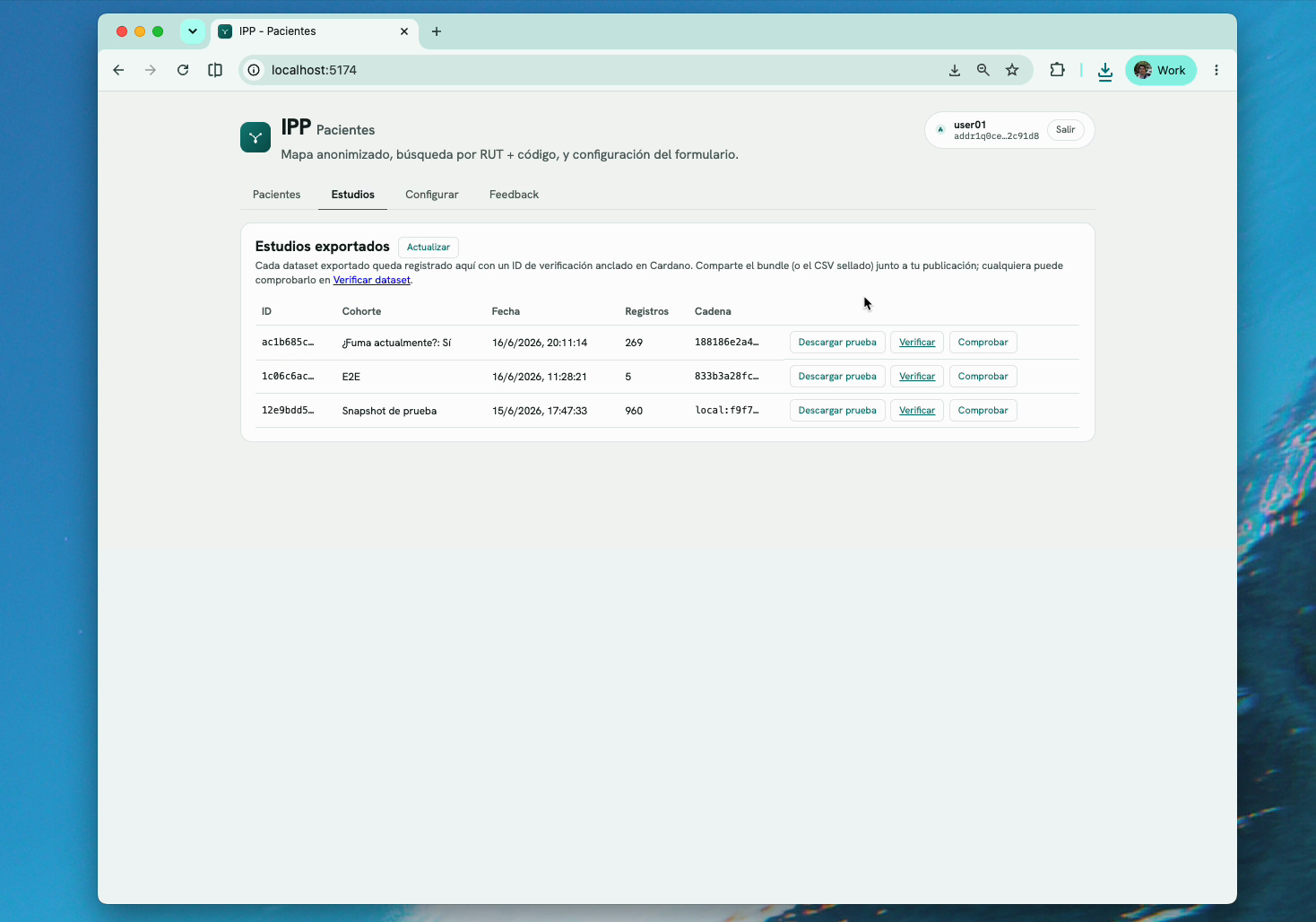 Exported studies, each a cohort: the on-chain column links every study to its
Cardano anchor, so anyone can verify a downloaded dataset against the chain.
Exported studies, each a cohort: the on-chain column links every study to its
Cardano anchor, so anyone can verify a downloaded dataset against the chain.
How EffectStream made the rest disappear
The interesting part isn't submitting a transaction - it's reading chain state back as application state. EffectStream does that with one command and a few lines of glue:
- Local dev is one command.
cd cardano && bun run devbrings up a local Cardano node + faucet, an indexer, a local database, and the sync node - everything runs on a single machine for development. - A primitive turns chain data into rows. EffectStream's
CardanoTransferprimitive streams each transaction's metadata; a ~15-line state-machine transition filters for label8327and writes{ tx, kind, k, v, block }into anipp_anchorstable. - The app reads a table, not the chain. Verification -
GET /verify/:rutand the map's "Verify on chain" popup - just queriesipp_anchors. The chain is the source of truth; the synced table is the always-available read model.
The backend's CardanoAdapter
(backend/src/adapters/cardano.ts)
is under 120 lines and only knows two things: how to build a metadata
transaction with Lucid, and
how to read ipp_anchors. Flip CHAIN=cardano in backend/.env and the same
endpoints that ran against a no-op local adapter now anchor and verify on a
real chain - no endpoint changes.
What New Use-Cases Does the GPS and AR Integration Enable
Putting location and augmentation at the centre of clinical capture unlocks things a filing-cabinet records system simply cannot:
- Route scarce specialists to where the need is. Because every record geocodes (GPS), the map shows where pelvic-floor need clusters - not just that it exists. A health service can look at a region and decide "send a specialist to this zone." That planning was impossible when cases lived on paper in separate clinics.
- Context at the point of care (location-based AR). As a clinician fills a field, the app augments it live with how this patient compares to their local area, their country, and the world - so a blank field becomes a field with meaning. On the map, clinicians draw notes and areas over the real geography, turning raw points into an intervention plan.
- Capture that becomes verifiable research. A filtered cohort is anchored to Cardano as a study (one Merkle root), so the data a clinician gathers can finally go somewhere - a dataset a journal or co-author can validate without ever seeing a private record.
- Cheaper triage, by more hands. A guided, location-aware intake turns an expensive specialist task into a quick structured form, so non-specialist staff can capture cases and scarce specialist time goes to treatment.
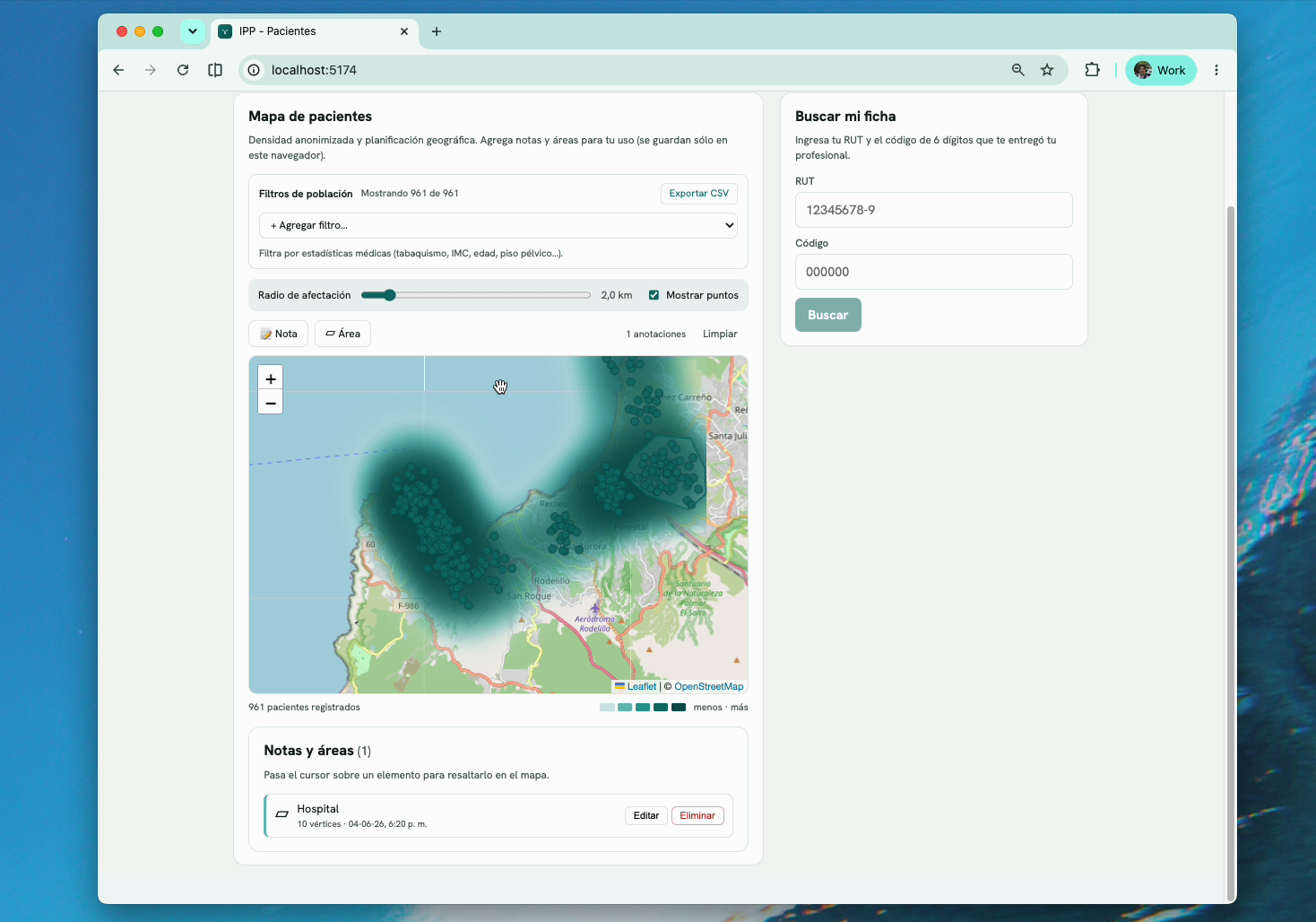 The web viewer's map: records as a geographic density layer over the region,
with clinician-drawn notes and areas - so you can see where need concentrates.
The web viewer's map: records as a geographic density layer over the region,
with clinician-drawn notes and areas - so you can see where need concentrates.
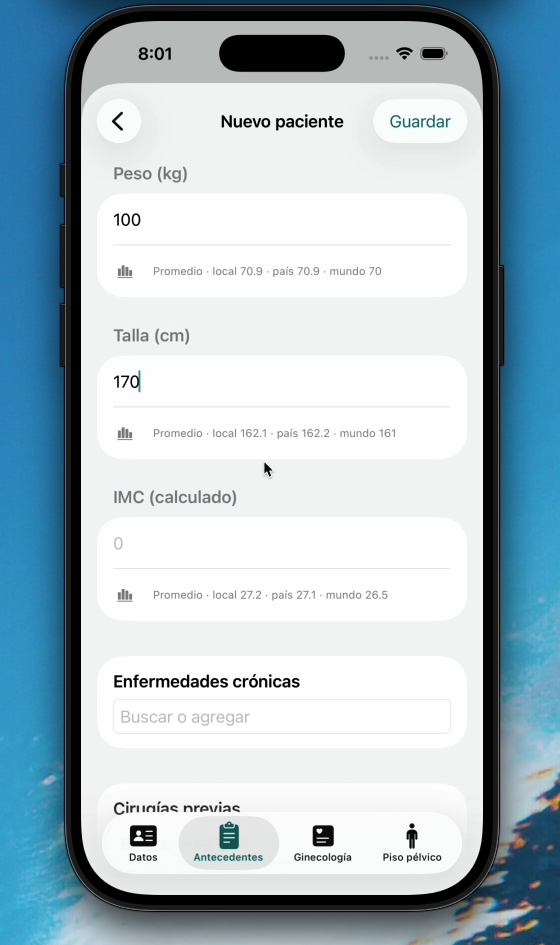 Location-based AR at capture: under each field, the app overlays the average value
for the patient's locality, country, and the world. It is subtle but powerful -
the clinician instantly sees how this patient compares to local norms, and
weighing each value against its context makes data-entry errors far less likely.
Location-based AR at capture: under each field, the app overlays the average value
for the patient's locality, country, and the world. It is subtle but powerful -
the clinician instantly sees how this patient compares to local norms, and
weighing each value against its context makes data-entry errors far less likely.
Why We Prioritized GPS and AR Integration for iOS
Three deliberate choices, each driven by the clinic, not the spec:
- Why GPS. Pelvic-floor need is unevenly distributed and the specialists who treat it are scarce. Without location you can only count cases; with it you can route care. Geo-location is the difference between a list and a plan.
- Why location-based AR. The hard part of an intake form is not storing the answer - it is knowing whether the answer is unusual. Our AR is anchored to physical place through GPS rather than to a camera feed: the app overlays the local / country / world average beneath each field, which does two things at once - it gives the clinician an instant sense of the norm for that location, and it cuts data-entry errors, because a value that is off compared to its context makes you stop and check. The paper form could never do that.
- Why iOS. Every clinician and non-medical professional in the pilot already carried an iPhone, so iOS was the fastest path to real hands-on use and the only platform we needed to target. The app ships signed requests, an embedded web dashboard, and a deterministic per-account wallet.
From the field: a closed testnet in Chile
The testnet existed to answer one question: would clinicians actually use this, or is it just a nice demo? The answer was a clear yes - and that yes is the result that mattered most.
The form, the fields, and the priorities did not come from a spec - they came from doctors. We ran a closed pilot in three neighbouring cities in Chile with practising clinicians who needed exactly this tool and who gave us the requirements and hints that shaped it. We chose the pilot cities with the clinicians themselves rather than through Discord or Twitter polls - not a single targeted user of this template is reachable on those platforms, so community interest had to be measured where this community actually is: in the clinics. The women's-health and pelvic-floor instruments in the app are theirs. We deployed it the simplest way possible - by hand, installing the app on each doctor's own iPhone. Every one of them already carried one, so iOS was the right (and only) target.
After a few weeks of real use, the pilot worked: the app helped triage patients, and it was used actively because the data it gathered was genuinely useful day to day - not a demo, a working instrument.
A walkthrough of the IPP app - capturing a record, anchoring its hash to Cardano, and exploring the geographic density map.
What the clinicians said
These summarize the feedback clinicians commonly gave us:
- "It has helped me skip reviewing documents just to triage."
- "I needed to add a question, and I could add it myself."
- "I could delegate the first quick review to other non-medical professionals."
- "We midwives are usually the first to see these patients, and having validated questions helps."
- "For the first time, we are seeing the data add up without manual labor."
A few things we learned that no amount of planning would have surfaced:
- Doctors asked to add other people. Doctors wanted to sign up non-medical staff so they could phone patients and fill the form on their behalf. The single-doctor login model didn't match how a clinic actually runs - a clear signal for delegated / role-based access next. Also an open registry.
- Almost all the feedback was about fields - which questions to add, drop, or reword. We need to make them resolve this, as we are not medical experts. That is exactly the case the schema-driven form was built for: we changed the questionnaire live from the web "Configure" tab, with no App Store release, and the change reached every device on next launch.
- They were happy and proactive. Adoption wasn't a push - clinicians kept asking for changes because they wanted to keep using it.
- The open question is who pays. They liked it; pushing it top-down into hospitals is hard. When we asked about willingness to pay, the clinicians who wanted to do research and publish papers were comfortable with a subscription - the same people the gamified leaderboard already rewards. That points the business model at the researchers, not the hospital procurement office.
One deliberate constraint: we anchored to a private Cardano testnet,
not a public network. Chile's rules for what health-derived data may be committed
to a public blockchain are something we are still working through with local law,
so we kept the anchors on a network we control while that review continues. The
architecture makes this a non-event - only hashes ever reach the chain (never
a RUT or a record), and the swappable ChainAdapter means moving from the private
testnet to a public Cardano network is a configuration change, not a rewrite, the
day the legal picture is clear.
The bigger takeaway outlived the pilot: there is a large, underserved space for low-cost tools in medicine, and where one actually shows up, the demand is real. The hard part was never the app - it is the compliance surface around health data. What makes that tractable is the shape of the legislation in countries like Chile, where a small team can ship something genuinely compliant and useful without the cost structure that keeps this kind of tool out of reach elsewhere. The privacy-preserving anchor - hashes on chain, records never - is part of how a low-cost tool stays on the right side of that line.
What's next
The pilot pointed at clear next moves:
- Delegated, role-based access. Different users need different views, so the next version makes that first-class: a clinic account with per-person roles, so whoever phones the patient isn't borrowing the doctor's identity.
- From a private testnet to a public chain. The anchor design already keeps only hashes on chain, so going public is a configuration flip - gated on finishing the review of what Chilean law allows on a public ledger.
- Publishable proof bundles. Turn a filtered cohort into a downloadable proof - a Merkle root plus per-record inclusion proofs - so a journal or co-author can verify a dataset against the chain without trusting us or seeing a single private record.
- A subscription for the people who publish. Willingness to pay was clearest among the research-minded clinicians, so the business model follows them, with the leaderboard doubling as the signal of who those power users are.
- Wider rollout, more instruments. More cities and clinics, and beyond pelvic-floor into other intake forms - the schema-driven form makes a new questionnaire a configuration change, not a new app.
How to use it yourself
IPP is intentionally thin - clone it (see Try it) and most of the surface generalizes. The pieces worth lifting:
- The iOS app. A SwiftUI app whose form is schema-driven: four tabs and ~70 questions rendered from a server-side JSON schema, so you add / reorder / relabel questions with no App Store release. Signed requests, an embedded web dashboard, and a deterministic per-account wallet come with it.
- GPS + location-based AR. CoreLocation geocoding feeds a Leaflet population map with stat filters and a distance radius; at capture each field is overlaid with local / country / world context, and on the map you draw notes and areas to plan interventions. The whole location-plus-augmentation layer drops into any field-data app.
- Gamification. Points and a leaderboard as a social-regulation and incentive layer - reusable anywhere you need contributors to keep feeding a dataset (and, as the pilot showed, to surface who your paying users are).
- The metadata-anchor pattern. A label plus
{ t, k, v }is the smallest useful Cardano anchor for any "I have private data, I want to prove it hasn't changed" application. No contract required. - The primitive → table sync. The
CardanoTransferprimitive + a tiny state transition is a clean template for any "watch chain metadata, project it into an app table" use case. - The schema-driven form. The questionnaire is a JSON schema stored in Postgres, fetched and cached by both clients; any vertical that needs a configurable intake form - surveys, audits, field inspections - can drop it in.
- The mock-wallet derivation. Each demo account derives a deterministic Cardano-style address from username + password, identical byte-for-byte between Swift and TypeScript. A teaching aid, not a security primitive.
The code is open-source; PRs against the demo repo are welcome.
Why this matters
Privacy-preserving verifiability is one of those phrases that sounds abstract until a real record is in front of you. Health data is one of the cleanest examples - the data itself must stay private, but the guarantee that it hasn't been silently edited is the difference between a record and a story.
EffectStream's job here is to make that combination cheap to assemble. The interesting work in IPP is the SwiftUI form, the Chilean clinical instruments, and the schema editor - the parts specific to this application. The Cardano stack underneath is a metadata transaction, one sync primitive, and an orchestrator command. That ratio is the point.
Try it
git clone https://github.com/effectstream/ipp-app
cd ipp-app
# Cardano - local node + indexer + sync node, all on one machine
cd cardano && bun install && bun run dev
# Backend (separate terminal)
cd ../backend && cp .env.example .env   # set DATABASE_URL; CHAIN=cardano
bun install && bun run dev               # http://localhost:3334
# Web viewer (separate terminal)
cd ../web && bun install && bun run dev   # http://localhost:5174
# iOS app
cd ../ios && xcodegen generate && open IPP.xcodeproj
Anchored records show up in ipp_anchors with a real Cardano tx_id. The
patient's RUT and record stay off-chain; only their hashes ever touch the chain.
NOTE: All data is shown in videos and images are synthetic. Real patient, or physician names are non-public due to legal requirements.