A Farcaster Mini App that Cardano wallets can vote in
Farcaster is an EVM-native platform. When you build a Mini App on Warpcast, the default assumption is that your users have a Base wallet. But Cardano wallet holders -- Lace, Eternl, Nami, NuFi users -- are in the Farcaster ecosystem too, and building two separate apps to serve both audiences is the obvious option. With EffectStream it isn't the necessary one.
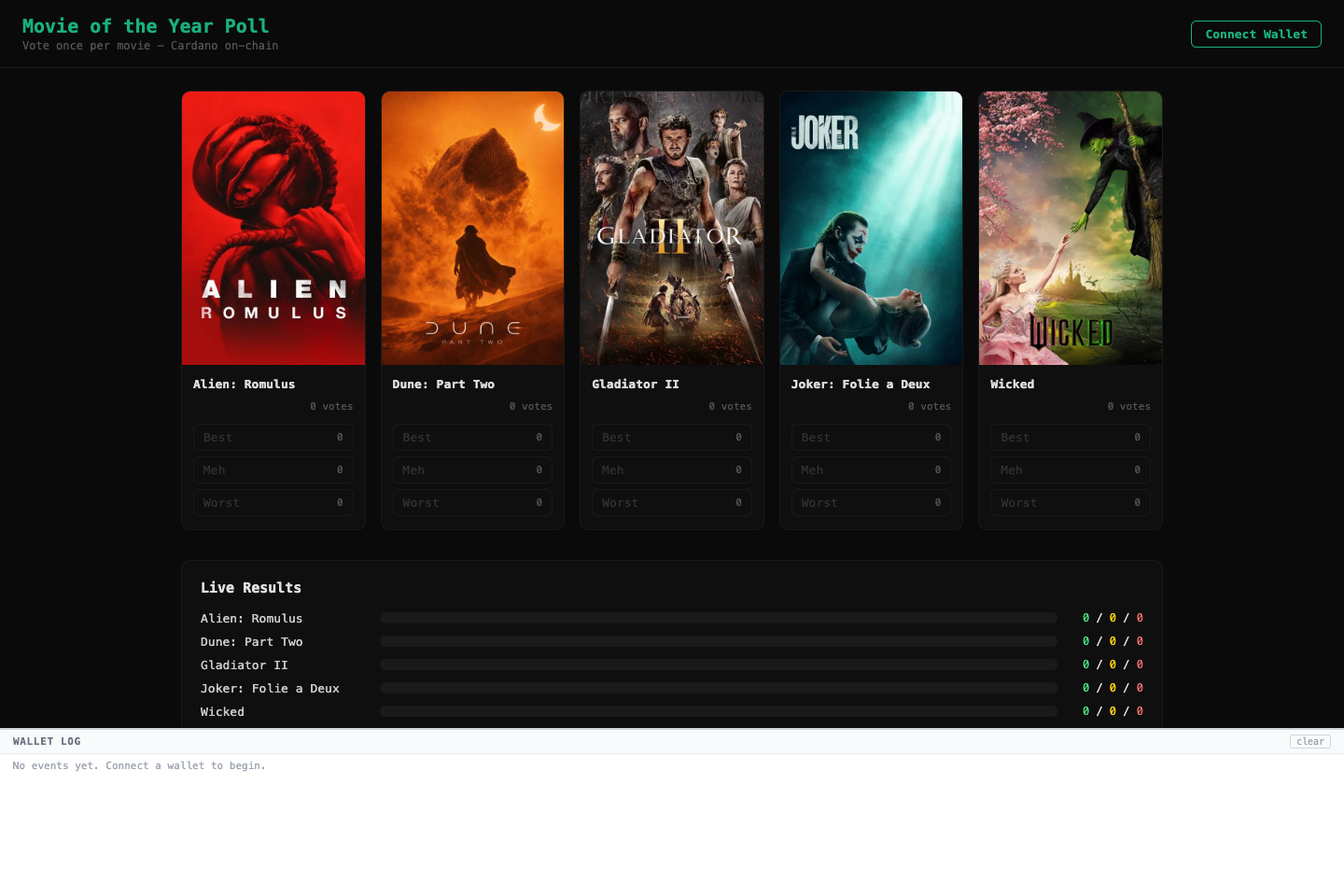
This is a build log for the Movie of the Year Poll: five 2024 films, three ratings (Best / Meh / Worst), one vote per wallet per movie, live results. The same Postgres schema, the same state machine, and the same frontend serve both paths -- the only difference is a config file.
Where the code comes from
The starting point is farcaster-canvas, a collaborative pixel-painting game that runs as a Farcaster Mini App. The previous post covers the full architecture. The short version: every line of app-specific logic lives in exactly four files inside packages/node/. Everything else -- the batcher, the node runtime, the wallet injection layer, the Postgres connection pool, the Vite frontend shell -- is shared infrastructure that you keep unchanged.
| File | farcaster-canvas | Movie poll |
|---|---|---|
packages/node/grammar.ts | fork, paint | cardano-vote |
packages/node/state-machine.ts | Canvas fork / fill logic | Vote deduplication + insert |
packages/database/migrations/000-init.sql | canvases, paints, rewards | movies, votes |
packages/node/api.ts | /api/canvases, /api/canvas/:id | /api/movies, /api/results |
What's actually Farcaster-specific
Everything described so far - the grammar, the state machine, the schema, the API, the chain config - is chain-agnostic EffectStream infrastructure. The entire Farcaster integration is exactly two things.
1. The embed manifest. Warpcast fetches /.well-known/farcaster.json before opening any Mini App frame. The file is a signed JSON object with three fields:
{
  "header": "eyJhbGciOiJFZERTQSIsInR5cCI6Ikp...",
  "payload": "eyJhcHBVcmwiOiJodHRwczovL215YX...",
  "signature": "MjA5YWM5NTI0ZjYwZDI4..."
}
payload is a base64-encoded object that declares the app URL, splash screen, and webhook endpoint. signature is an EdDSA signature from the developer's Farcaster account key. You generate it once with the Farcaster developer portal and serve it as a static file. That's the entire embed integration.
2. The wallet connector. Inside Warpcast, window.ethereum and EIP-6963 wallet announces don't exist. The Farcaster Mini App SDK exposes an EIP-1193 provider at sdk.wallet.ethProvider instead. Outside Warpcast, in a regular browser, you want MetaMask, Rabby, Coinbase, or any EIP-6963 wallet. The useWallet.ts hook resolves the right provider in priority order:
// 1. Farcaster Mini App host -- the only path that works inside Warpcast.
//    sdk.wallet.ethProvider is direct; the SDK's own EIP-6963 announce is
//    async (Comlink -> host -> postMessage back) and races against discovery.
// 2. EIP-6963 multi-injected providers (MetaMask, Rabby, Coinbase, etc.).
// 3. Legacy window.ethereum -- old wallets that never adopted EIP-6963.
One hook, both contexts, no code fork. When the Cardano wallet path is active, this hook is simply unused - LucidEvolution handles the Cardano side directly.
Everything else in the template is standard EffectStream scaffolding.
How a Cardano vote works end to end
The EVM path for this kind of app is well-documented: user signs an off-chain message, the batcher bundles it, a contract emits an event, the indexer picks it up. Cardano is more direct -- no batcher, no contract -- and the mechanics are worth spelling out.
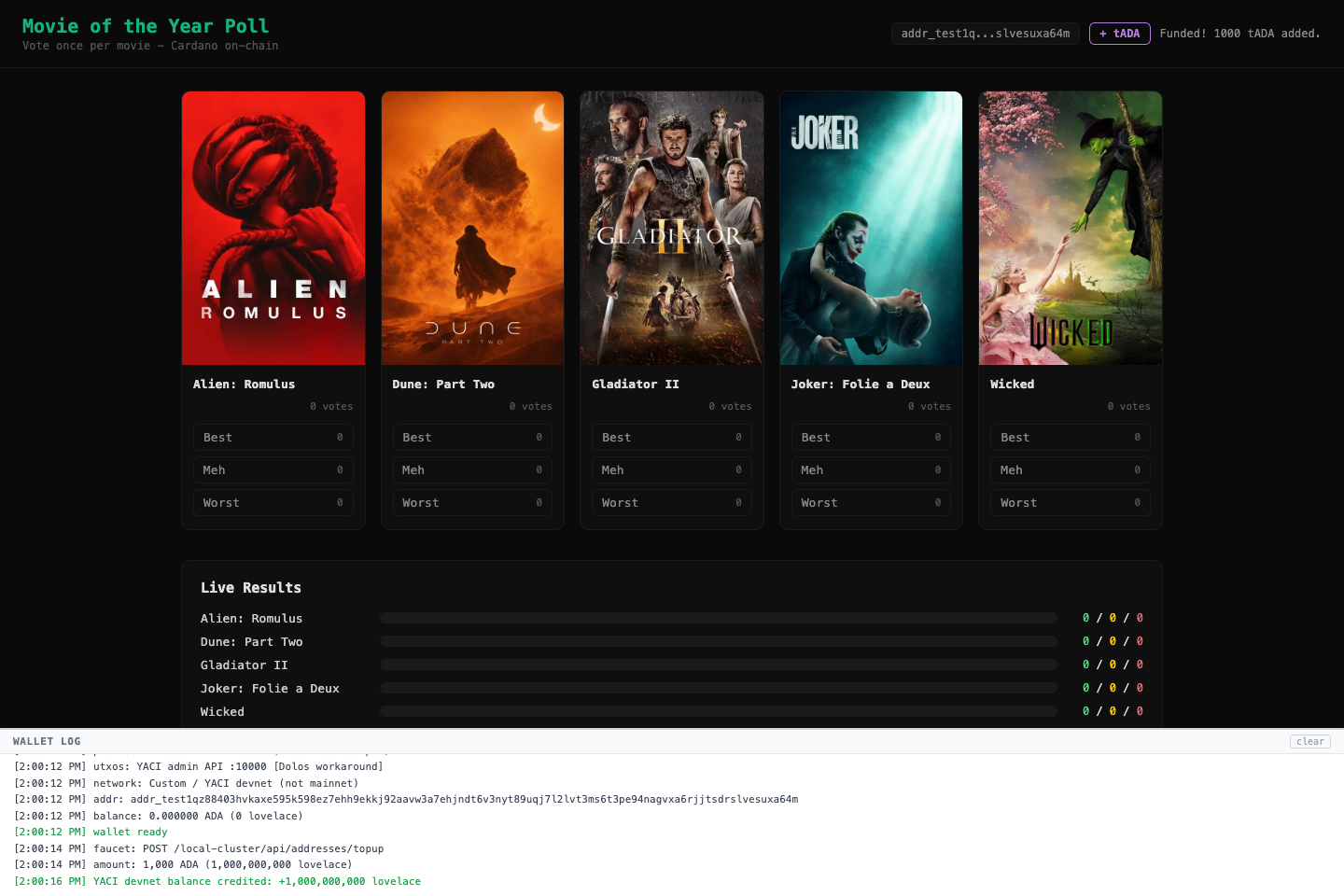
1. The wallet is generated from a BIP-39 mnemonic via LucidEvolution's fromSeed. In the dev setup it's an ephemeral hot wallet; production would use browser wallet injection (Lace, Eternl, etc.) instead. A YACI devnet faucet tops it up with test ADA.
2. The transaction carries the vote as Cardano transaction metadata at label 7890. Lucid builds and signs it:
const tx = await lucid
  .newTx()
  .pay.ToAddress(walletAddress, { lovelace: 2_000_000n })
  .attachMetadata(7890n, { movie: movieId, rating })
  .complete();
const signed = await tx.sign.withWallet().complete();
const txHash = await signed.submit();
The 2_000_000n lovelace (2 ADA) output is required by the Cardano minimum UTxO rule -- every transaction output must carry at least a small amount of ADA. Sending to your own address keeps the cost minimal; the metadata is the actual payload.
3. Metadata serialization is a subtlety worth knowing. Cardano serializes metadata maps as [{k, v}] arrays, not plain JSON objects. What you wrote as { movie: "dune2", rating: "best" } arrives in the indexer as:
[{"k": "movie", "v": "dune2"}, {"k": "rating", "v": "best"}]
The state machine iterates the pairs explicitly.
4. Voter identity comes from inputCredentials -- the first vkey witness hash on the Cardano transaction. This is more crypto-native than an address: it is the hash of the actual signing key, regardless of which address the user controls. The state machine uses it as the deduplication key.
5. Block ingestion runs through Dolos MiniBF (a UTxORPC relay) connected to the YACI devnet. PrimitiveTypeCardanoTransfer watches for transactions that match the grammar prefix, extracts the metadata, and feeds a typed input into the state machine for each block.
6. Deduplication is enforced at the database layer. The votes table has a UNIQUE(movie_id, voter) constraint and the insert uses ON CONFLICT DO NOTHING. If the same wallet submits a second vote for the same movie, the transaction lands on chain and the indexer processes it, but the row is silently dropped. No error, no user-visible failure.
The wallet log in the UI makes the full flow visible:
The four files
grammar.ts
The grammar declares what inputs the app recognizes. cardanoTransfer is a builtin that captures txId, metadata, inputCredentials, and outputs from any Cardano transfer -- we alias it under our own name:
export const grammar = {
  "cardano-vote": builtinGrammars.cardanoTransfer,
} as const satisfies GrammarDefinition;
state-machine.ts
const VALID_MOVIES  = new Set(["dune2","gladiator2","wicked","alien","joker2"]);
const VALID_RATINGS = new Set(["best","meh","worst"]);

stm.addStateTransition("cardano-vote", function* (data) {
  const { txId, metadata, inputCredentials } = data.parsedInput;

  // Voter = first vkey witness hash (signing key identity, not address).
  let voter = txId;
  try {
    const creds = JSON.parse(inputCredentials);
    if (creds[0]) voter = creds[0];
  } catch {}

  // Cardano metadata maps arrive as [{k, v}] pairs.
  let movie, rating;
  try {
    const entry = JSON.parse(metadata)?.["7890"];
    if (Array.isArray(entry))
      for (const { k, v } of entry) {
        if (k === "movie")  movie  = String(v);
        if (k === "rating") rating = String(v);
      }
  } catch {}

  if (!movie || !VALID_MOVIES.has(movie)) return;
  if (!rating || !VALID_RATINGS.has(rating)) return;

  yield* World.resolve(insertVote, {
    movie_id: movie, voter, rating,
    tx_hash: txId, block_height: data.blockHeight,
  });
});
Thirty lines. No chain code, no wallet code, no event publishing -- the runtime handles all of that outside this function.
schema
CREATE TABLE movies (id TEXT PRIMARY KEY, title TEXT NOT NULL);
INSERT INTO movies VALUES
  ('dune2','Dune: Part Two'), ('gladiator2','Gladiator II'),
  ('wicked','Wicked'), ('alien','Alien: Romulus'),
  ('joker2','Joker: Folie a Deux');

CREATE TABLE votes (
  id           SERIAL PRIMARY KEY,
  movie_id     TEXT    NOT NULL REFERENCES movies(id),
  voter        TEXT    NOT NULL,
  rating       TEXT    NOT NULL CHECK (rating IN ('best','meh','worst')),
  tx_hash      TEXT    NOT NULL,
  block_height INTEGER NOT NULL,
  UNIQUE (movie_id, voter)
);
api.ts
Two read endpoints. The frontend polls /api/results every two seconds to update the bar chart:
server.get("/api/results", async (_req, reply) => {
  const result = await dbConn.query(`
    SELECT m.id, m.title,
      COUNT(CASE WHEN v.rating = 'best'  THEN 1 END)::int AS best_count,
      COUNT(CASE WHEN v.rating = 'meh'   THEN 1 END)::int AS meh_count,
      COUNT(CASE WHEN v.rating = 'worst' THEN 1 END)::int AS worst_count,
      COUNT(v.id)::int AS total
    FROM movies m LEFT JOIN votes v ON m.id = v.movie_id
    GROUP BY m.id, m.title ORDER BY best_count DESC
  `);
  reply.send(result.rows);
});
The frontend
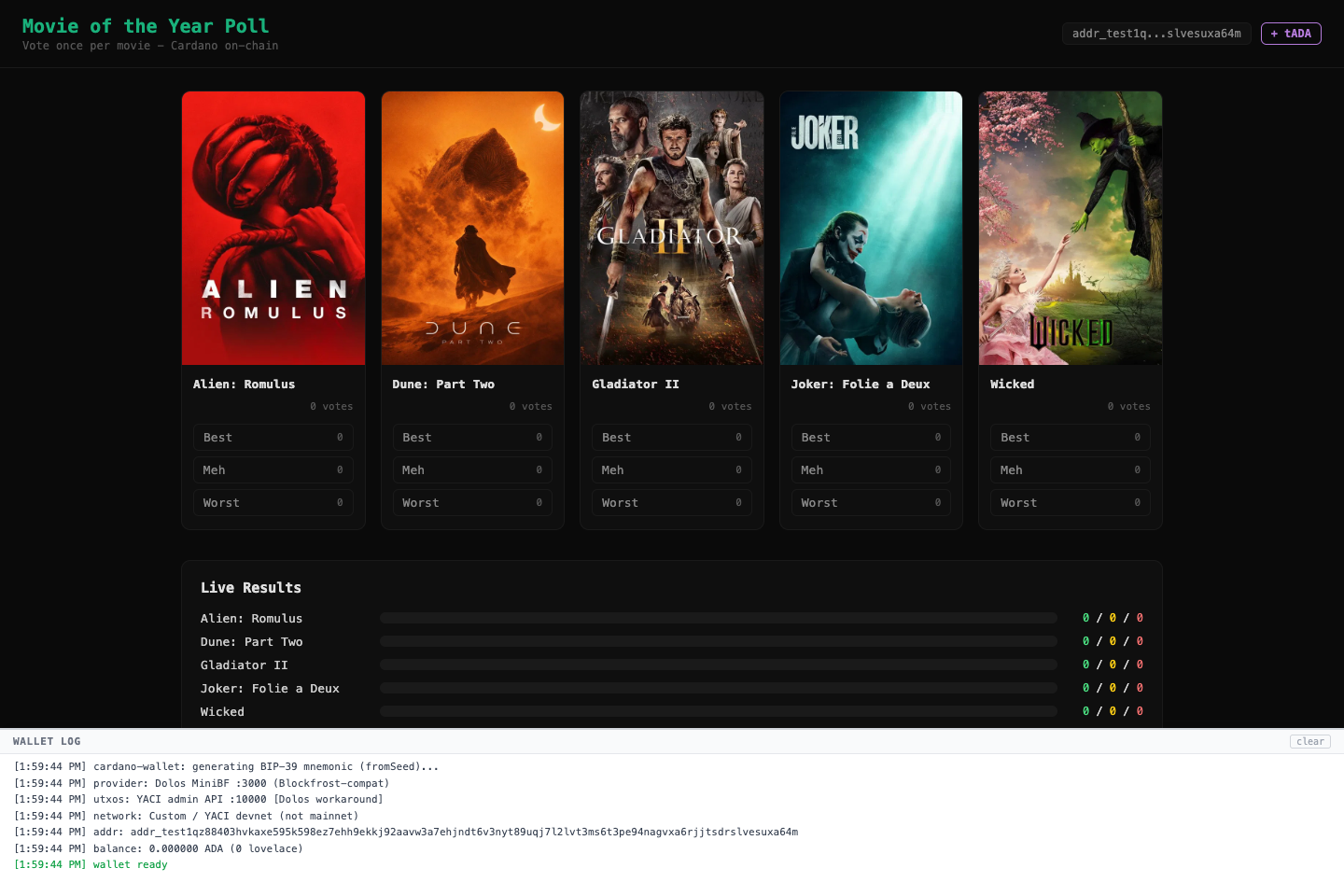
The frontend is a React + Vite app that ships inside packages/frontend/. Five MovieCard components render in a grid - each shows the TMDB poster, live vote counts, and Best / Meh / Worst buttons. A log panel at the bottom records wallet activity and chain events in real time: key generation, faucet TX, metadata construction, submission hash, and block confirmation as each step completes. Results come from polling /api/results every two seconds; the counts update live as votes land on chain.
This is plain React - no special EffectStream frontend library. You can replace it with anything that can hit an HTTP endpoint.
Config is the chain
The four app files are identical whether the settlement chain is EVM or Cardano. The only thing that changes is the wiring in config.dev.ts. Here is the relevant diff from the canvas game to the poll:
- .addViemNetwork({ ...hardhat, name: "evmMain" })
+ .addNetwork({ name: "yaci", type: Yaci, adminApiUrl: "http://localhost:10000" })

- .addParallel(n => n.evmMain, n => ({
-   name: "canvas-l2", type: EVM_RPC_PARALLEL, chainUri: n.rpcUrls[0],
- }))
+ .addParallel(n => n.yaci, n => ({
+   name: "cardano-utxorpc", type: CARDANO_UTXORPC_PARALLEL,
+   rpcUrl: "http://127.0.0.1:50051",
+ }))

- .addPrimitive(s => s["canvas-l2"], () => ({
-   type: PrimitiveTypeEVMEffectstreamL2,
-   contractAddress: "0x...",
- }))
+ .addPrimitive(s => s["cardano-utxorpc"], () => ({
+   type: PrimitiveTypeCardanoTransfer,
+   stateMachinePrefix: "cardano-vote",
+ }))
The grammar, state machine, schema, and API are untouched. Swapping back to EVM - or supporting both simultaneously - means restoring the removed lines. The same poll would accept votes from Base and Cardano wallets in the same results table with no code changes to the app layer.
Get started
git clone https://github.com/effectstream/farcaster-app my-poll
cd my-poll
bun install

# Replace the four game files, then:
bun run dev
The orchestrator boots PGLite + the local chain + the node + the frontend in one command. For Cardano, apply the config diff above and bun run dev switches to YACI DevKit + Dolos automatically. Open http://localhost:10599, connect the ephemeral wallet, hit the faucet, and vote.
The farcaster-canvas template and this poll are both at https://github.com/effectstream/farcaster-app.